
In the annals of church history, the “Avignon Papacy” of the 14th century stands as a stark reminder of what happens when Christ’s Church is swallowed by an empire. For nearly seventy years, the papal seat was forcibly dragged from Rome to Avignon, France, effectively turning the successors of Peter i(according to Catholic tradition) into political tools of the French Crown. It was a period marked not by an outright hatred of God, but by something far more insidious: a superpower’s desire to capture, domesticate, and weaponize the divine to serve nationalistic ambitions.

The Main Subject: A central, middle-aged figure in full 14th-century Papal white and red regalia (The Pope) is standing, arms locked and tense, eyes closed in anguished prayer.
The Threat: Instead of cardinals or ancient kings surrounding him, he is encircled by translucent, ghostly, shifting holographic projections of modern, predatory US Pentagon officials (suit jackets and tactical gear, holding generic ‘threat’ documents or data pads). They are pressing in, aggressively shouting demands that are visibly turning into faint, corrupting lines of glitch-code on the ancient stone.
The Action: The ground beneath the Pope is starting to split into the same glitch-code, threatening to pull him down toward a “Wide Path” that is physically materializing beneath him. It is a stunning, cinematic clash of ancient stone and data.
History, it seems, is clearing its throat.
The present, considering a return to the past.
Not long ago, a chilling report surfaced detailing a tense, behind-the-scenes rift between the Pentagon and the Vatican. Stripped of diplomatic pleasantries, the message from the administration to the Holy See was clear: Align with our global and national agenda, or face the consequences. To the casual observer, this looks like standard geopolitical friction. But to those with eyes to see, it reveals the re-emergence of an ancient, predatory archetype. It is the unveiling of the Pharaoh Mindset—the mechanical instinct of a secular state attempting to “capture” the Church and force it to burn incense at the altar of civil religion.
The architects of this pressure campaign aren’t necessarily (or literally) “anti-God.” Like Nebuchadnezzar standing before the fiery furnace, they are perfectly willing to acknowledge God’s greatness when it suits them. But the moment the Church—acting as the representative of a higher Kingdom—challenges their national idols or questions their geopolitical doctrines, the mask slips. The state immediately reverts to the Pharaoh route of intimidation, leverage, and forced compliance. They do not hate God; they simply want a God who serves the state. In other words, they want to remake God in their image.
Before going any further, let’s see what was the big deal about the Avignon papacy?
The Avignon Papacy
Rome, the Vatican, the Pope – they all go together, right? Well, not always.
🤖✨ The Avignon Papacy (1309–1377) saw papal residence shift from Rome to the French city of Avignon, a change driven primarily by political circumstances rather than theological conviction.1 When the French prelate Clement V was elected pope in 1309, he refused to leave France and instead conducted his office from his residence there—a pattern that continued through seven successive French popes until 1378.2
This relocation had profound consequences for papal authority and reputation. Although technically part of the Papal States, Avignon lay within French territory, making the papacy vulnerable to French royal influence and ultimately becoming “colonized” by France itself.1 The French kings of Western Europe’s wealthiest and most powerful kingdom wielded considerable influence over papal decisions, and of 134 cardinals created during this period, 113 were French.2 This transparent favoritism damaged the papacy’s standing among other emerging European nations.2
1 Owen F. Cummings, Amazing Grace! Windows in the Christian Tradition of Thinking about Grace (New York, NY: Cascade Books, 2023). [See here, here, here.]
2 James R. Payton Jr., Getting the Reformation Wrong: Correcting Some Misunderstandings (Westmont, IL: IVP Academic, 2010), 31–33.
In the instance above, it wasn’t a wide path seduction. It was a wide path forceful relocation.
But now, the scenario causing the current rift between the Pope and the U.S. government is different. It’s much more serious. The Avignon incident was about taxes. The U.S. issue, as we’ll see, is for the hearts and minds of Catholics. And the “penalty” before was being relocated to France. The U.S. government has no issue going into a country by force, killing people in the process of “extracting” (kidnapping) people they think aren’t within the realm of the America First doctrine. Much more serious.
But it’s still a threat of a forceful wide path relocation.
Here’s an excerpt from a Newsweek article: Avignon Papacy Explained: What Reported US Threat to Pope and Vatican Means:
✏️ The Free Press recently reported a closed-door Pentagon meeting in January during which a Trump senior official referenced the “Avignon papacy” to Vatican officials as the conversation between the two parties got heated.
In his reporting, Mattia Ferraresi calls the meeting at the Pentagon—for which there is no public record—the culmination of months of brewing tensions between Donald Trump and Pope Leo XIV.
Under Secretary of War for Policy Elbridge Colby reportedly summoned Cardinal Christophe Pierre, Pope Leo XIV’s then-ambassador to the U.S., to the Pentagon after the pope’s January state-of-the-world address, which was interpreted as hostile to the Trump administration.
A line that particularly enraged officials reportedly was the one saying that “a diplomacy that promotes dialogue and seeks consensus among all parties is being replaced by a diplomacy based on force.”
According to Ferraresi and Vatican expert Christopher Hale, this statement was taken as a criticism of Trump’s “Donroe Doctrine,” his update of the “Monroe Doctrine” which supports U.S. dominance on the Western Hemisphere backed by military force.
As things got heated, Colby reportedly lectured Cardinal Pierre on the military power of the U.S. and told him that the Catholic Church must pick a side, according to Hale, and mentioned the “Avignon papacy.”
All information about the meeting was obtained by Ferraresi from Vatican and U.S. officials briefed on the Pentagon meeting.
Newsweek
Sure sounds like a threat to me.
And what got it all going? This, from the Free Press link above:
✏️ On Easter Sunday, Leo XIV urged world leaders to lay down weapons and choose peace—to drop the “desire to dominate others.” It was the culmination of a rhetorical escalation against the Iran war that grew in intensity over Holy Week, when he condemned “the imperialist occupation of the world” and warned that God rejects the prayers “of those who wage war.”
The Free Press
Now, you can choose to disagree with the Pope, but what he said is well within the realm of his responsibility as leader of the Roman Catholic Church. Telling him he needs to take a side, and if he doesn’t pick the U.S. government of the moment’s side that he needs to remember Avignon is clearly putting the U.S. government over the Pope on something he’s not only entitled to speak on – but should.
Does God reject the prayers of those who wage war?
Whether or not God “rejects” the prayers of those who wage war is definitely a question of semantics, undoubtedly a question of how one interprets the Bible, and I’m sure any number of other things come into the discussion as well.
However, the one thing I’ll say now is this. Christians believe – or at least I believe are taught to believe – that God will answer prayers when our will aligns with His.
Of course, that enters the question of “what is God’s will” into the equation. That is answerable only by scripture – which, of course, we don’t agree on how to interpret.
Therefore, we’re down to one last thing. Is what the Pope was told – to remember what happened in Avignon – appropriate? And that comes down to, essentially, if it’s OK to threaten the Pope? As it pertains to Christians, I don’t believe it’s appropriate for an administration that acts as this one does towards even those it allegedly considers friends, to treat the Pope in that manner.
Of course, as always, you’re free to disagree with me. But then, you don’t need to answer to me. But you may have to answer to God. Not a threat. Just a possible reality in the future. N’est-ce pas?
Oh yeah – where does that leave you – on the narrow path or the wide path?
Well, let’s move on. We’ll see examples as we go, showing what’s happening and how events line up with scripture.
July 4th and Lampedusa
This one didn’t get as much attention as the Avignon incident, but it did make the news. The Vice President – certainly with Presidential approval or initiation, invited the Pope to a July 4th Celebration here in the U.S. You may ask, Why? The most obvious answer, based on past invitations to leaders he doesn’t like is that it’s an opportunity to attack and/or embarrass someone. You can just do a web search on that tendency – I don’t feel a need to add anything else on it.
In any case:
What’s happening on July 4th?
There’s a fascinating schedule of events for this day.
- The WFC fight originally planned for July 4th was rescheduled to Flag Day in June. Coincidentally (?) it also happens to be Trump’s birthday.
- There will be a ceremony, with a keynote address by the President from the south lawn. I assume the grass will be put back after the fight, since it’s going to be completely destroyed by the fight.
- The President and First Lady will host an Independence Day celebration on the South Lawn featuring a traditional barbecue and flyovers by military aircraft to honor service members, veterans, and first responders.
- There will be an attempt to break a fireworks Guinness World Record that night.
- Along with that, there will be “spiritual and religious events.
- While the events are civic, American patriotic music historically blurs the line with faith. You will hear traditional American hymns or anthems like the “Battle Hymn of the Republic” (notably featured in celebratory projects like “America’s Soundtrack”)1
- Additionally, famous faith-affiliated groups, such as The Tabernacle Choir at Temple Square (formerly the Mormon Tabernacle Choir), have a deep history of performing at major Washington milestones—including past inaugurations for President Trump. When these groups perform on the civic stage, they shift their focus from strictly religious worship to a “God and Country” style patriotic tribute, honoring American freedom of religion and heritage rather than a specific church doctrine.[mfn per Google Gemini
Given the combination of patriotic, civic, and war themes, combined with generic spiritual and religious themes all being mashed together, one can easily see why the Pope doesn’t want to be seen as endorsing that combination.
So, the Pope is skipping that and going to wait – where?
Where is Lampedusa and why is Pope Leo going there?
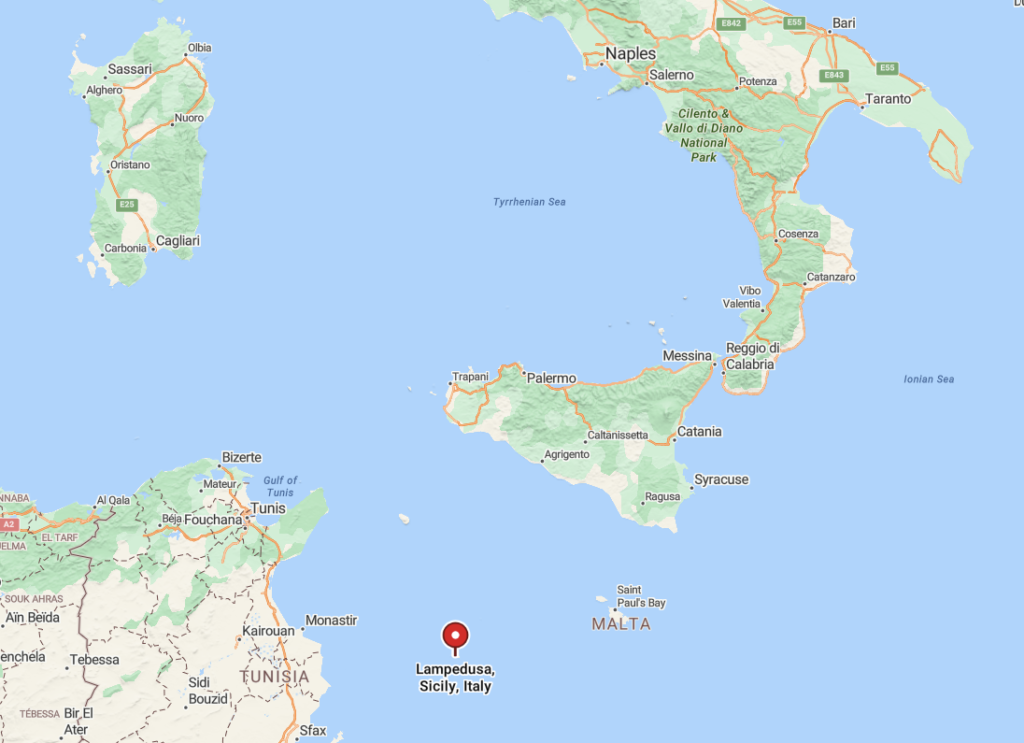
All that can be seen in the pin from Google Maps, but that’s where Lampedusa is.
Tripadvisor.com says of this island:
Italy’s southernmost island, Lampedusa lies between Malta and Tunisia and is geographically part of the African continent. The largest of the Pelagian Islands, Lampedusa is arid and gets its only fresh water from rainfall. In summer, it is served by low-cost Italian airlines with direct flights from several mainland cities, as well as ferry service from Sicily. Lampedusa is treasured by visitors for its fine white sandy beaches, its clear turquoise waters and its excellent scuba diving.
But that’s not why Pope Leo is going there. Far from it. EWTN Global Catholic Network says of the Pope’s upcoming trip that includes Lampedusa:
✏️ Pope Leo XIV will travel July 4 to the southern Mediterranean island of Lampedusa, a major migrant landing point that has become a symbol of Europe’s migration emergency as tens of thousands of migrants arrive there each year after perilous sea crossings.
The Vatican on Thursday published a calendar of the pope’s Italian pastoral visits through Aug. 22, including stops in Pompei, Naples, Acerra, Pavia, Assisi, and Rimini.
Lampedusa — a small Italian island south of Sicily — gained worldwide attention as a flashpoint of Mediterranean migration and as a place of mourning for those who died trying to reach Europe. Pope Francis chose Lampedusa as the destination of his first official visit outside Rome on July 8, 2013, when he prayed for victims lost at sea and decried indifference toward migrants.
Leo’s planned visit also comes after he has spoken publicly about the U.S. migration debate, supporting a letter by the U.S. Catholic bishops last year opposing the mass deportation policy of the Trump administration and calling for humane treatment of migrants.
EWTN
The bottom line here is this: The Pope is doing what we call “walking the walk” as well as “talking the talk”. Staying on the narrow path.
But then, what does he get for it? He gets verbally attacked and threatened.
But that kind of treatment by the U.S. government is avoidable.
Current U.S. Administration is co-opting a flavor of Christianity and taking it to the wide path
You do remember the narrow and the wide paths, right?
The Narrow and Wide Gates – Matthew
Mt 7:13 “Enter through the narrow gate. For wide is the gate and broad is the road that leads to destruction, and many enter through it. 14 But small is the gate and narrow the road that leads to life, and only a few find it.”
Even in Trump’s first election, he pandered to Christians, especially Evangelical Christians. It’s beyond me how a person like him can convince so many people that he’s the best thing ever to happen to Christianity. I have asked before – do morals not matter? Does the way we treat people not matter? Does truth not matter?
There are too many things to go into here, so I’ll be writing more and bringing back some things I wrote during his first campaign and first presidency. and his second campaign, which he can’t even honestly talk about. And the third one. And what he’s doing to people around the world now. You know – our neighbors? At least, for those of us who still believe in Jesus and try to follow His teaching, examples, and commands. We still remember:
The Parable of the Good Samaritan – Luke
10:25-28 pp — Mt 22:34-40; Mk 12:28-31
Lk 10:25 On one occasion an expert in the law stood up to test Jesus. “Teacher,” he asked, “what must I do to inherit eternal life?”
Lk 10:26 “What is written in the Law?” he replied. “How do you read it?”
Lk 10:27 He answered: “ ‘Love the Lord your God with all your heart and with all your soul and with all your strength and with all your mind’; and, ‘Love your neighbor as yourself.’’”
Lk 10:28 “You have answered correctly,” Jesus replied. “Do this and you will live.”
Lk 10:29 But he wanted to justify himself, so he asked Jesus, “And who is my neighbor?”
Lk 10:30 In reply Jesus said: “A man was going down from Jerusalem to Jericho, when he fell into the hands of robbers. They stripped him of his clothes, beat him and went away, leaving him half dead. 31 A priest happened to be going down the same road, and when he saw the man, he passed by on the other side. 32 So too, a Levite, when he came to the place and saw him, passed by on the other side. 33 But a Samaritan, as he traveled, came where the man was; and when he saw him, he took pity on him. 34 He went to him and bandaged his wounds, pouring on oil and wine. Then he put the man on his own donkey, took him to an inn and took care of him. 35 The next day he took out two silver coins and gave them to the innkeeper. ‘Look after him,’ he said, ‘and when I return, I will reimburse you for any extra expense you may have.’
Lk 10:36 “Which of these three do you think was a neighbor to the man who fell into the hands of robbers?”
Lk 10:37 The expert in the law replied, “The one who had mercy on him.”
Jesus told him, “Go and do likewise.”
I just wrote about this parable in Are we the good Samaritan? Or the robber?
Conclusion: The Clash of Sovereignties: Part 1 of The Wide-Path Seduction
There’s no doubt as to whether there’s a clash of sovereignties going on. If you’ve read this far, you probably think you know what it’s about. You know who the parties are to this clash.
But then, there’s a good chance you’re wrong. If you think it’s Trump and his administration against the various American churches, the Roman Catholic Church, or any other denomination, thanks for guessing – but you’re wrong.
If you’re Christian, and you picked them as the groups I’m writing about – think again. Dig deeper.
And come back for part 2 of the Clash of Sovereignties, where I’ll tell you who I believe is involved. And why.
Footnotes:
- 1
- Additionally, famous faith-affiliated groups, such as The Tabernacle Choir at Temple Square (formerly the Mormon Tabernacle Choir), have a deep history of performing at major Washington milestones—including past inaugurations for President Trump. When these groups perform on the civic stage, they shift their focus from strictly religious worship to a “God and Country” style patriotic tribute, honoring American freedom of religion and heritage rather than a specific church doctrine.[mfn per Google Gemini ↩︎
Discover more from Which god can save?
Subscribe to get the latest posts sent to your email.