
This article isn’t finished yet, but world events appear to be accelerating in ways that make me think it’s wiser to publish a partial version now rather than wait. I’ve included the questions I’ll be examining, along with an introduction to the approach I’m taking.
Tonight and tomorrow, I’ll be finishing the full article — including biblically grounded answers and my own reflections. But even with just the framework in place, you can begin your own reflection today. Consider how these questions touch your life as a Christian, or how they might offer a new perspective on what those of us who truly follow Jesus believe.
We’re living in a moment where political rhetoric is loud, fear is high, and claims of divine backing are being thrown around with increasing confidence. This post isn’t written so much for non‑Christians —you’re not expected to see the world through the same lens. This is for believers. It’s a “look in the mirror” moment, a chance to ask who truly holds first place in our hearts. Although, I do hope non-Christians will read it and learn the truth about those of us who truly try to follow Jesus.
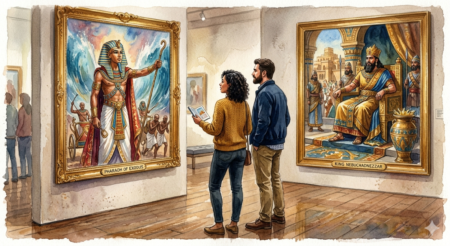
Two patterns Scripture gives us for discernment.
The adjacent watercolor captures the moment I’m trying to describe: a modern couple standing in a quiet gallery, contemplating two ancient kings whose stories still echo today.
Pharaoh and Nebuchadnezzar faced the same crossroads — truth confronting power — and each responded differently. One hardened his heart until disaster was unavoidable. The other eventually humbled himself and found clarity.
Their portraits hang near each other and yet on different walls, as in Scripture – a reminder that every generation, and every leader, reaches a similar moment. And so do we.
Living a Christian Life
It’s not easy, but Scripture does call us to live a certain kind of life. For instance, consider just these two passages.
Final Instructions for living a Christian life
The first is a passage titled “Final Instructions”. It’s not about the end of our lives. And make no mistake, these are far from afterthoughts at the end of a letter either.
Final Instructions – 1 Thessalonians
1Th 5:12 Now we ask you, brothers, to respect those who work hard among you, who are over you in the Lord and who admonish you. 13 Hold them in the highest regard in love because of their work. Live in peace with each other. 14 And we urge you, brothers, warn those who are idle, encourage the timid, help the weak, be patient with everyone. 15 Make sure that nobody pays back wrong for wrong, but always try to be kind to each other and to everyone else.
1Th 5:16 Be joyful always; 17 pray continually; 18 give thanks in all circumstances, for this is God’s will for you in Christ Jesus.
1Th 5:19 Do not put out the Spirit’s fire; 20 do not treat prophecies with contempt. 21 Test everything. Hold on to the good. 22 Avoid every kind of evil.
1Th 5:23 May God himself, the God of peace, sanctify you through and through. May your whole spirit, soul and body be kept blameless at the coming of our Lord Jesus Christ. 24 The one who calls you is faithful and he will do it.
1Th 5:25 Brothers, pray for us. 26 Greet all the brothers with a holy kiss. 27 I charge you before the Lord to have this letter read to all the brothers.
1Th 5:28 The grace of our Lord Jesus Christ be with you.
Of course, the highlighted verse is the obvious choice out of the passage: “Test everything. Hold on to the good.” That means we should, while testing everything as usual, with discernment to be able to tell what’s pleasing to God and what isn’t, consider all these things as well: Live in God’s joy (not the same at all as the normal definition of joy); pray – consider God in all things; Do not ignore the Holy Spirit to the point of never paying attention; remember and respect prophecies; avoid what is evil.
Yes, all of those things are important, or should be, for Christians. And if we remember, those things were defined both Pharaoh and Nebuchadnezzar. And so, for us, the task is to look at our leaders. Are their words, actions, policies, etc., in line with the way we’re expected to live as Christians. In Christian terms, be discerning about our leaders. And if/when they get far enough out of line from the way we should live – what are we going to do?
The Christian life is a living sacrifice to God
The second passage is “Living Sacrifices”, which is about conforming to the ways of the world. It calls on us to remember that just as Jesus was the ultimate sacrifice for the sins of all who accept God’s offer of salvation, our lives are also a sacrifice – in that we promised to give up our desires in this life to live the kind of life that will honor God.
Living Sacrifices – Romans
Ro 12:1 Therefore, I urge you, brothers, in view of God’s mercy, to offer your bodies as living sacrifices, holy and pleasing to God—this is your spiritual act of worship. 2 Do not conform any longer to the pattern of this world, but be transformed by the renewing of your mind. Then you will be able to test and approve what God’s will is—his good, pleasing and perfect will.
...
No. this isn’t talking about sacrifices in the Old Testament style of sacrificing animals for sins. And obviously, it’s not the same as Jesus dying on the cross. Rather, this is about what Christians call dying to self. It’s where we give up the desires we had before becoming Christian, and instead do things that line up with what pleases God. Of course, it takes time to be able to do that. When Paul wrote: “Do not conform any longer to the pattern of this world, but be transformed by the renewing of your mind. Then you will be able to test and approve what God’s will is—his good, pleasing and perfect will”, he didn’t mean it was an instant success thing. It takes practice. And of course, discernment.
With that as background, you probably have a question or two. Maybe more. But let’s start with this one: What does any of this have to do with that opening sentence: We’re living in a moment where political rhetoric is loud, fear is high, and claims of divine backing are being thrown around with increasing confidence.
The Biblical Pattern: God Chooses the Battles, Not Us
Well, the heading is a hint about what we’ll examine today. A news headline from this morning brings the topic front and center: Rattled Trump plots major escalation as his war backfires. This isn’t about whether or not Trump is rattled. Honestly, it doesn’t matter. it’s the possible – not planned – but being prepared for escalation. He’s literally all over the map on whether or not the escalation will happen. And yet, even though there’s supposedly been no planning, real marines are on their way to the Middle East.
And that is what makes this article important. If we are to be discerning, we must be aware of the possibilities, the realities – as much as we can, and begin praying for discernment on how things like this affect our allegiance to the One we promised to follow. Jesus, who died on the cross for us.
Who are we following as our “god”?
The very first of the Ten Commandments, which were not repealed but were summed up by Jesus, is:
Ex 20:3 “You shall have no other gods before me”.
And then later, Jesus said:
The Greatest Commandment – Matthew
22:34-40 pp — Mk 12:28-31
Mt 22:34 Hearing that Jesus had silenced the Sadducees, the Pharisees got together. 35 One of them, an expert in the law, tested him with this question: 36 “Teacher, which is the greatest commandment in the Law?”
Mt 22:37 Jesus replied: “ ‘Love the Lord your God with all your heart and with all your soul and with all your mind.’ 38 This is the first and greatest commandment. 39 And the second is like it: ‘Love your neighbor as yourself.’ 40 All the Law and the Prophets hang on these two commandments.”
And so, the very first question for us to answers, as followers of Jesus is, quite simply: who is our “god”? Is it Jesus Christ? or is it a human – regardless of the person’s name, state of mind, etc.
What does “this “Rattled Trump plots major escalation as his war backfires” and the current state of affairs in Iran have to do with Pharaoh and Nebuchadnezzar? Well, the latest news, as of the time I’m writing this is: Trump says ‘a whole civilization will die tonight’ ahead of deadline for Iran. That’s Trump putting himself into a Pharaoh / Nebuchadnezzar situation.
Yes, that certainly has huge implications for the world. But let’s not lose sight of something else. It also has implications for every person who voted for and/or supports Trump and what he’s doing to people – millions of people in the Middle East, millions of people in America – and billions of people around the world.
That all should be obvious. But let’s go back to the question of, “Who is our God?” Jesus said we cannot serve two masters. We’ll get more into that in a bit, but let me say now, we cannot serve both Jesus and Trump. No matter what he or anyone claiming otherwise might say, Trump and his kind do not serve Jesus.
And so, for anyone who truly wants to follow Jesus – we need to decide if our God is Jesus Christ, the Son of God, as revealed in the New Testament – or the one way too many people have made in the image they want to see.
With that in mind, let’s go back to Egypt, with the Israelites & Pharaoh.
The setup for the plagues in Exodus: God, Moses and Aaron
I’m going to assume that you’re at least familiar with what happened in Exodus. If not, you can start at Summary of the Book of Exodus – Bible Survey | GotQuestions.org and go deeper from there if you’d like.
I’m going to start with the end of Chapter 6, where God describes, from a very high level, what’s about to happen.
Aaron to Speak for Moses – Exodus
Ex 6:28 Now when the LORD spoke to Moses in Egypt, 29 he said to him, “I am the LORD. Tell Pharaoh king of Egypt everything I tell you.”
Ex 6:30 But Moses said to the LORD, “Since I speak with faltering lips, why would Pharaoh listen to me?”
Ex 7:1 Then the LORD said to Moses, “See, I have made you like God to Pharaoh, and your brother Aaron will be your prophet. 2 You are to say everything I command you, and your brother Aaron is to tell Pharaoh to let the Israelites go out of his country. 3 But I will harden Pharaoh’s heart, and though I multiply my miraculous signs and wonders in Egypt, 4 he will not listen to you. Then I will lay my hand on Egypt and with mighty acts of judgment I will bring out my divisions, my people the Israelites. 5 And the Egyptians will know that I am the LORD when I stretch out my hand against Egypt and bring the Israelites out of it.”
Ex 7:6 Moses and Aaron did just as the LORD commanded them. 7 Moses was eighty years old and Aaron eighty-three when they spoke to Pharaoh.
Notice – God tells Moses: “See, I have made you like God to Pharaoh, and your brother Aaron will be your prophet.”
I point this out to clearly show who’s who. God doesn’t speak directly to Pharaoh. But, when Moses speaks God’s words to Pharaoh, Pharaoh will see him as God. And Aaron will be seen as a prophet from God assigned to Moses.
It’s important to realize this. It’s not like Moses claims something out of thin air – or just makes up a story about being God’s representative. Nor is Aaron making claims on Moses’ behalf.
The hardening of Pharaoh’s heart during the plagues in Egypt
There’s one more thing to notice before going any deeper into the plagues. It’s something that many people miss. Sadly, it’s because it’s not at all apparent in the English translations that there’s more to the hardening of Pharaoh’s heart than a simple, “God did it!”
To see how it all went down – and put in in a logical order, I went through a 9-part Q&A with the LOGOS/Faithlife AI Agent on topic ranging from Pharaoh to Nebuchadnezzar to us to Jesus.
I know, some people don’t like using AI with anything, much less Christianity and the Bible. The thing is, even with an AI engine that’s put out by a Christian organization, the onus is still on us, Christians, to be the discerning ones. To verify what it says really does line up with God’s Word, that the context is considered fully and correctly, and to be discerning when we come up with conclusions.
So, at the end of this Q&A session, my last comment – after verifying the responses I received to my queries – was:
Interesting. I know all these verses – but never made that connection to the Revelation passage. It really ties things together and brings them home.
With that as our backdrop, let’s see how I came to make that statement.
When did God harden Pharaoh’s heart and make it unchangeable?
Did you catch that part about and make it unchangeable? It’s incredibly important. There’s something going on that, as I mentioned, isn’t obvious at all in English. Yes, the earlier verse we looked at says, “But I will harden Pharaoh’s heart, and though I multiply my miraculous signs and wonders in Egypt, he will not listen to you.” The thing is, it’s pretty common in the Bible for a summary to be given of something – and then it’s followed up later in more detail.
Maybe you noticed, that happened in Genesis, with the creation of Adam and Eve. My mother told me once, that she liked the second creation of Adam and Eve better than the first. I had to ask, what second creation? It only happened once. She actually though God did it twice. How or why she thought that? Who knows. But she never knew, after decades of being Catholic and studying Hebrew and Judaism, she had no idea it was one and the same event – with more description in the second telling of it.
My point is – that short passage we looked at was a short statement, minus details, of what was about to take place. Now, we’re going to look at some of the details and see what the “hardening of Pharaoh’s heart” actually entailed. It’s not, as many assume, a case of Pharaoh never had a chance. He did. He had several chances. Eventually, God gave Pharaoh what he wanted – and that’s when his fate was sealed.
during the plagues in Exodus, Pharaoh finally reached a point at which God hardened Paharoah’s heart where it was prevented him from changing his mind. Which plague was that?
exactly. And then one more time – after the loss of the first born for all Egyptians households without the blook of the lam on the doorpost – Pharaoh let the Israelites go, but then decided to send his troops to try to kill them. was that considered a softening of sorts – or he let them go out of fear – and then he reneged on that to track them down and try to kill them
let’s turn to an opposite reaction – Nebuchadnezzar – and when he finally turned to God but not until after his time “eating grass”
so then the main differentiation – if we can try to narrow it down – is Pharaoh’s anger and fear as opposed to King N.’s humiliation – where the humiliation comes from us seeing where we are compared to where we could be (with God) as opposed to the anger / fear which blinds us to everything else?
That’s an interesting twist – they protect the illusion. it fits in with the self-defense mechanism. If there more on that aspect of the differences in these two men – and in people in general when confronted with the reality of who we are and who we could be?
Question
the one constant is the presence or absence of God in our lives. And at some point the, with His perfect foreknowledge, God will give us what we want – life with our without Him. Even if that though, there is a lesson for people in general, even the the case of Pharaoh – that while God does allow bad things to happen in this world – it is fallen after all – that the person at the center of it is given a change to change – and the rest of us have an opportunity to “whine about God allowing this”, or learning that there’s a reason He allows it and we can choose to learn from it, or not.
But there is the one instance of what must take place – it’s both the best and the worst at the same time – depending on, of course, whether God is in our life or not: Rev 4:1 After this I looked, and there before me was a door standing open in heaven. And the voice I had first heard speaking to me like a trumpet said, “Come up here, and I will show you what must take place after this.”
I didn’t realize this part before: The “must” in “what must take place after this” is the same word Jesus used to describe his necessary suffering, the destiny laid upon him by his Father. Which Gospel / chapter/verse is this?
Discover more from Which god can save?
Subscribe to get the latest posts sent to your email.