
Easter is supposed to be the season of hope – yet many Christians aren’t sure what, exactly, we’re hoping for. We talk about resurrection every year, but somewhere along the way the word lost its weight. For many people, “resurrection” has quietly become a metaphor, a spiritual idea, or a poetic way of saying that life goes on. Somehow.
But the earliest Christians didn’t treat resurrection as a symbol. They staked everything on something far more concrete – and far more surprising than some realize.
If Easter is about anything, it’s about God restoring what He created in the beginning. Not an escape from the physical world, but the renewal of it. Not the shedding of a body, but the promise of a new one.
There’s a quote coming up that totally shocked me when I read it.
I often write about the difference between believing in and believing God. I also write, maybe not often enough, about picking and choosing what we want to believe.
Maybe that’s what is happening here – it’s hard to say. But clearly, as the author concludes – this kind of thinking draws into question whether we really believe in anything at all.
Easter. Resurrection day. But what kind of resurrection?
✏️ The major Christian creeds state,
“I believe in the resurrection of the body.”
…
But I have found in many conversations that Christians tend to spiritualize the resurrection of the dead, effectively denying it. They don’t reject it as a doctrine, but they deny its essential meaning: a permanent return to a physical existence in a physical universe. Of Americans who believe in a resurrection of the dead, two-thirds believe they will not have bodies after the resurrection.…
But this is self-contradictory.
…A non-physical resurrection is like a sunless sunrise. There’s no such thing. Resurrection means that we will have bodies. If we didn’t have bodies, we wouldn’t be resurrected!
Christopher D. Hudson; “Heaven and Hell: Are They Real?”
That last point deserves repetition – and emphasis!
🔍 Key Insight
A non-physical resurrection is like a sunless sunrise.
There’s no such thing.
Resurrection means that we will have bodies.
If we didn’t have bodies, we wouldn’t be resurrected!
Easter and resurrection are about renewal?
Are Easter and the resurrection really about a renewal? Where does it say that?
Well, let’s first re-examine the beginning. Literally.
In the Beginning
To see why this kind of thinking is wrong, we go all the way back to the beginning.
The beginning of us.
The beginning of humans, given the breath of life by God.
Adam and Eve – Genesis
Ge 2:4 This is the account of the heavens and the earth when they were created.
When the LORD God made the earth and the heavens— 5 and no shrub of the field had yet appeared on the earth and no plant of the field had yet sprung up, for the LORD God had not sent rain on the earth and there was no man to work the ground, 6 but streams came up from the earth and watered the whole surface of the ground— 7 the LORD God formed the man from the dust of the ground and breathed into his nostrils the breath of life, and the man became a living being.
Ge 2:8 Now the LORD God had planted a garden in the east, in Eden; and there he put the man he had formed. 9 And the LORD God made all kinds of trees grow out of the ground—trees that were pleasing to the eye and good for food. In the middle of the garden were the tree of life and the tree of the knowledge of good and evil.
Ge 2:10 A river watering the garden flowed from Eden; from there it was separated into four headwaters. 11 The name of the first is the Pishon; it winds through the entire land of Havilah, where there is gold. 12 (The gold of that land is good; aromatic resin and onyx are also there.) 13 The name of the second river is the Gihon; it winds through the entire land of Cush. 14 The name of the third river is the Tigris; it runs along the east side of Asshur. And the fourth river is the Euphrates.
Ge 2:15 The LORD God took the man and put him in the Garden of Eden to work it and take care of it. 16 And the LORD God commanded the man, “You are free to eat from any tree in the garden; 17 but you must not eat from the tree of the knowledge of good and evil, for when you eat of it you will surely die.”
Ge 2:18 The LORD God said, “It is not good for the man to be alone. I will make a helper suitable for him.”
Ge 2:19 Now the LORD God had formed out of the ground all the beasts of the field and all the birds of the air. He brought them to the man to see what he would name them; and whatever the man called each living creature, that was its name. 20 So the man gave names to all the livestock, the birds of the air and all the beasts of the field.
But for Adam no suitable helper was found. 21 So the LORD God caused the man to fall into a deep sleep; and while he was sleeping, he took one of the man’s ribs and closed up the place with flesh. 22 Then the LORD God made a woman from the rib he had taken out of the man, and he brought her to the man.
Ge 2:23 The man said,
“This is now bone of my bones
and flesh of my flesh;
she shall be called ‘woman,’
for she was taken out of man.”
Ge 2:24 For this reason a man will leave his father and mother and be united to his wife, and they will become one flesh.
Ge 2:25 The man and his wife were both naked, and they felt no shame.
Please note – as we are told in verse 17 – this is before the fall. Adam and Eve had not yet eaten from the Tree of the Knowledge of Good and Evil. Therefore, they were not yet subject to death. They had immortal bodies.
🔍 Key Insight
Adam and Eve were created with immortal bodies.
So, what is resurrection?
Here’s the dictionary.com definition of resurrection –
- the act of rising from the dead.
- (initial capital letter) the rising of Christ after His death and burial.
- (initial capital letter) the rising of the dead on Judgment Day.
- the state of those risen from the dead.
- a rising again, as from decay, disuse, etc.; revival.
- Christian Science. a rising above mortality through the understanding of spiritual life as demonstrated by Jesus Christ.
If you happen to be a follower of Christian Science, then I guess you’re happy with this definition.
Unfortunately, all too many “Christians” also are happy with this definition.
Regardless of the name, there something we need to understand about Christian Science. Christian Science uses Christian language, but its core beliefs about God, Jesus, sin, and salvation are fundamentally different from historic Christianity.
Because the central teachings don’t line up with what Christians have historically believed, most Christian traditions don’t consider it part of Christianity.
🔍 Key Insight
Christian resurrection is not rising above mortality into a spiritual life of some sort.
And so, understanding that distinction, the problem with item #6 from dictionary.com is that it’s not what the Bible says!
What is Christian resurrection?
Given the different meanings/interpretations of resurrection, we need to find a definition from a Christian source. After all, if we’re Christian, it is the best source of information. As we’ll see, it’s different from the Jewish viewpoint – and, on beyond that, not all Jews even believe in a resurrection.
We begin with one from the New Bible Dictionary:
✏️ RESURRECTION. The most startling characteristic of the first Christian preaching is its emphasis on the resurrection. The first preachers were sure that Christ had risen, and sure, in consequence, that believers would in due course rise also. This set them off from all the other teachers of the ancient world. There are resurrections elsewhere, but none of them is like that of Christ. They are mostly mythological tales connected with the change of the season and the annual miracle of spring. The Gospels tell of an individual who truly died but overcame death by rising again. And if it is true that Christ’s resurrection bears no resemblance to anything in paganism it is also true that the attitude of believers to their own resurrection, the corollary of their Lord’s, is radically different from anything in the heathen world. Nothing is more characteristic of even the best thought of the day than its hopelessness in the face of death. Clearly the resurrection is of the very first importance for the Christian faith.
The Christian idea of resurrection is to be distinguished from both Greek and Jewish ideas. The Greeks thought of the body as a hindrance to true life and they looked for the time when the soul would be free from its shackles. They conceived of life after death in terms of the immortality of the soul, but they firmly rejected all ideas of resurrection (cf. the mockery of Paul’s preaching in Acts 17:32). The Jews were firmly persuaded of the values of the body, and thought these would not be lost. They thus looked for the body to be raised. But they thought it would be exactly the same body (Apocalypse of Baruch 1:2). The Christians thought of the body as being raised, but also transformed so as to be a suitable vehicle for the very different life of the age to come (1 Cor. 15:42ff.). The Christian idea is thus distinctive. 1Morris, L. L. (1996). Resurrection. In D. R. W. Wood, I. H. Marshall, A. R. Millard, J. I. Packer, & D. J. Wiseman (Eds.), New Bible dictionary (3rd ed., p. 1010). Leicester, England; Downers Grove, IL: InterVarsity Press.
New Bible dictionary
🔍 Reflective Insight
The Gospels tell of an individual who truly died but overcame death by rising again. And if it is true that Christ’s resurrection bears no resemblance to anything in paganism it is also true that the attitude of believers to their own resurrection, the corollary of their Lord’s, is radically different from anything in the heathen world. Nothing is more characteristic of even the best thought of the day than its hopelessness in the face of death.
Let’s look at one more, with a note on the importance of the Christian meaning of resurrection –
✏️ RESURRECTION From the Latin resurrectio, meaning “rising again.” A return to life after having died. Mainly refers to the resurrection of Christ – the central event of the Christian faith. Also refers to the Christian doctrine of corporate resurrection, which is connected to the judgment of both the living and the dead.
Introduction
The death and resurrection of Jesus Christ is central to the New Testament and foundational for the theology of the Church. These events have been acknowledged as paramount from the early church to the present. For example, Paul argues that if Jesus did not bodily rise from the dead as the firstfruit of believers, biblical faith is fallacious and ineffective, preaching is useless, apostolic witnesses were false, sin remains unforgiven, and believers have died without hope (1 Cor 15:12–19). He also asserts that Christians are misguided without this distinctive doctrine (1 Cor 15:32). 2Burns, J. L. (2016). Resurrection. In J. D. Barry, D. Bomar, D. R. Brown, R. Klippenstein, D. Mangum, C. Sinclair Wolcott, … W. Widder (Eds.), The Lexham Bible Dictionary. Bellingham, WA: Lexham Press.The Lexham Bible Dictionary
📜✝️ Core Truth
RESURRECTION From the Latin resurrectio, meaning “rising again.” A return to life after having died. Mainly refers to the resurrection of Christ – the central event of the Christian faith.
What are some of the key points that differentiate Christian resurrection from any other meaning of resurrection?
So, now that we’ve gone through some various views of what “resurrection” might mean, let’s put together a recap.
Some key points from the Christian definition that differentiate our belief in what that word means –
- We are to rise again, just as Jesus did.
As we’ll see in a moment, there are indicators given to show that Jesus did have a physical body after His resurrection. The fact that these things are included in the Bible should tell us that they are important. - The Christian definition of resurrection was different from the way others used the words thousands of years ago. Therefore, it should not be a surprise – and should in fact be expected – that we have a different interpretation of the word today.
- While others thought the body was a hindrance to the soul, Christians do not hold to that belief. Well, not exactly.
You see, others looked at the body the way it was while they were alive and concluded they would be better off without a body.- However, Christians have (or should have) a different perspective of the body. We saw that in the Genesis passages above. The bodies that Adam and Eve initially had were not subject to death. UNTIL they ate from the Tree of the Knowledge of Good and Evil. THEN, and ONLY THEN, were their bodies subject to death. And decay. And sickness.
- In other words, the bodies they had before the fall would not have been a hindrance to them. Those bodies would have lasted forever.
- So, the Christian expectation is that after we are resurrected, we will again have bodies that are not a hindrance. Bodies like Adam and Eve had before the fall. Bodies that will last forever.
- Going back to Jesus’ resurrection – if you remember – there was a lot of emphasis placed on “He is Risen”. On the body not being in the grave anymore. And those followers who were so depressed and demoralized after His crucifixion were all of a sudden more excited than ever after seeing Jesus in His risen body. If the body was no big deal, or was even something we expected to no longer have, then there would be no emphasis on Jesus being risen again, in His visible/physical body. In fact, no matter what happened after the crucifixion, they could have claimed that His Spirit was still alive.
- It would have been so much easier! Why all that emphasis on something that seemed so impossible – that others didn’t even want – unless the resurrected physical body was of tremendous importance!
- Looking at the reference to what Paul wrote, he went as far as to say that if there was no physical resurrection then “we are to be pitied more than all men“.
Now, we should have a pretty good idea of what Christian resurrection is about. What we believe.
Maybe it seems a bit much? For instance, why do we insist on something so impossible? Why do we talk about a body that’s so “good” that it won’t hinder the soul? I counter that with a different question. We believe our God is all powerful. Therefore, why do we expect anything less, especially when we have the early church witnesses who saw Jesus’ resurrection, and were willing to die rather than renounce Jesus and give up the right to have the promise of an eternal life, not only with the improved body but also with the God who created us?
How are you feeling about a non-bodily resurrection now?
We’ve seen a lot of evidence that a spiritual resurrection, without a body, is not Biblical.
But, as I said above, there’s more.
We have the example of Jesus Himself.
Even the Jewish leaders knew that a physical resurrection was important to the followers of Jesus, as we see below. While you read it, remember that the Sadducees didn’t even believe in resurrection for themselves, although the Pharisees did believe in the Jewish meaning of resurrection we saw earlier.
The Guard at the Tomb – Matthew
Mt 27:62 The next day, the one after Preparation Day, the chief priests and the Pharisees went to Pilate. 63 “Sir,” they said, “we remember that while he was still alive that deceiver said, ‘After three days I will rise again.’ 64 So give the order for the tomb to be made secure until the third day. Otherwise, his disciples may come and steal the body and tell the people that he has been raised from the dead. This last deception will be worse than the first.”
Mt 27:65 “Take a guard,” Pilate answered. “Go, make the tomb as secure as you know how.” 66 So they went and made the tomb secure by putting a seal on the stone and posting the guard.
As I said earlier – if the physical resurrection wasn’t important – then it certainly didn’t need to be part of the promise. Physical resurrection is the one thing that absolutely had to be proved! One cannot begin to prove a spiritual only resurrection. There’s nothing to point to and say, “See – there’s the proof”. Only the resurrection of a physical body requires proof.
And the Jewish leaders at the time knew this. That’s why they went to the trouble of going to the hated Romans and asked for protection of the tomb – so there could be no possibility of Jesus’ followers pulling some kind of trick with Jesus’ dead body and falsely claiming that He was risen.
If the Jewish leaders of the time knew this – how is it that so many Christians don’t know this today?
That’s a truly sad state of affairs for those who claim to be Christian, but don’t believe in a physical resurrection.
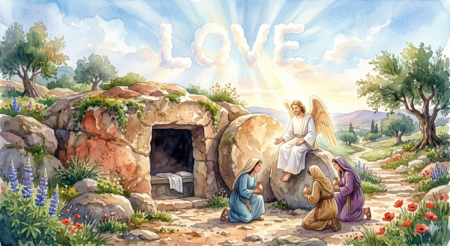
Now we reach the point where the image at the top of the page comes in.
Jesus’ resurrection
The Resurrection – Matthew
24:1-10 pp — Mt 28:1-8; Mk 16:1-8; Jn 20:1-8
Lk 24:1 On the first day of the week, very early in the morning, the women took the spices they had prepared and went to the tomb. 2 They found the stone rolled away from the tomb, 3 but when they entered, they did not find the body of the Lord Jesus. 4 While they were wondering about this, suddenly two men in clothes that gleamed like lightning stood beside them. 5 In their fright the women bowed down with their faces to the ground, but the men said to them, “Why do you look for the living among the dead? 6 He is not here; he has risen! Remember how he told you, while he was still with you in Galilee: 7 ‘The Son of Man must be delivered into the hands of sinful men, be crucified and on the third day be raised again.’ ” 8 Then they remembered his words.
Lk 24:9 When they came back from the tomb, they told all these things to the Eleven and to all the others. 10 It was Mary Magdalene, Joanna, Mary the mother of James, and the others with them who told this to the apostles. 11 But they did not believe the women, because their words seemed to them like nonsense. 12 Peter, however, got up and ran to the tomb. Bending over, he saw the strips of linen lying by themselves, and he went away, wondering to himself what had happened.
But there’s more. Jesus wanted to be seen by His followers.
More proof of the physical resurrection.
And also a chance to show us a bit of Jesus’ resurrection body.
Later, when Jesus appeared to His disciples, we see:
Jesus Appears to the Disciples – Luke
Lk 24:36 While they were still talking about this, Jesus himself stood among them and said to them, “Peace be with you.”
Lk 24:37 They were startled and frightened, thinking they saw a ghost. 38 He said to them, “Why are you troubled, and why do doubts rise in your minds? 39 Look at my hands and my feet. It is I myself! Touch me and see; a ghost does not have flesh and bones, as you see I have.”
Lk 24:40 When he had said this, he showed them his hands and feet. 41 And while they still did not believe it because of joy and amazement, he asked them, “Do you have anything here to eat?” 42 They gave him a piece of broiled fish, 43 and he took it and ate it in their presence.
Lk 24:44 He said to them, “This is what I told you while I was still with you: Everything must be fulfilled that is written about me in the Law of Moses, the Prophets and the Psalms.”
Lk 24:45 Then he opened their minds so they could understand the Scriptures. 46 He told them, “This is what is written: The Christ will suffer and rise from the dead on the third day, 47 and repentance and forgiveness of sins will be preached in his name to all nations, beginning at Jerusalem. 48 You are witnesses of these things. 49 I am going to send you what my Father has promised; but stay in the city until you have been clothed with power from on high.”
OK – Jesus appeared to even more people.
But did you notice verses 41 to 43?
41 … he asked them, “Do you have anything here to eat?” 42 They gave him a piece of broiled fish, 43 and he took it and ate it in their presence.
There is a lot in here. Jesus tells them they are witnesses. He reminds them of what He had taught them before – and that He has fulfilled everything.
And then Luke, the doctor, the one who was involved more heavily than the others in things of the body, records the fact that Jesus ate fish in the presence of the disciples. The disciples were also witnesses to the fact that Jesus, with His resurrection body, ate fish!
I love to eat fish – especially sushi and sashimi. Reading that Jesus ate fish, to me, is awesome. The prospect of getting the best fish ever in Heaven is something to look forward to. The fact that not only will it be better than any I’ve ever had before is amazing. I can’t imagine live Uni being better than some of what I’ve already had, but I’m ready and waiting. Add to that the fact that so many other things will make Heaven’s live Uni look like “nothing” – there aren’t even words to describe what it would be like.
Consideration of the resurrection body
These are the kinds of things we’ll have with our resurrection bodies.
Why would anyone consider them a hindrance?
Why would someone not want one?
Even more importantly – since the Bible, through Jesus and the Holy Spirit, tells us that we will have a resurrection body –
how can we possibly not believe that it’s true?
How can we be so led astray by the ways of this world that we refuse to believe the promises of the One we claim to want to spend eternity with?
Or – are we so focused on this world, and the way it is right now, that we think God can’t really make all things new again – make them right?
If that’s the case – do we even know God?
I totally believe what the Bible says about a resurrection body.
And I look forward to it.
I look at life the way it is in the world today – and I don’t like it. I’d hate to spend forever like this.
But I also believe God when He says He will make all things new –
The New Jerusalem – Revelation
Rev 21:1 Then I saw a new heaven and a new earth, for the first heaven and the first earth had passed away, and there was no longer any sea. 2 I saw the Holy City, the new Jerusalem, coming down out of heaven from God, prepared as a bride beautifully dressed for her husband. 3 And I heard a loud voice from the throne saying, “Now the dwelling of God is with men, and he will live with them. They will be his people, and God himself will be with them and be their God. 4 He will wipe every tear from their eyes. There will be no more death or mourning or crying or pain, for the old order of things has passed away.”
Rev 21:5 He who was seated on the throne said, “I am making everything new!” Then he said, “Write this down, for these words are trustworthy and true.”
…
What do we – you – believe?
Let’s look at that early quote on Christian creeds one more time –
✏️ “The major Christian creeds state, “I believe in the resurrection of the body.”
But I have found in many conversations that Christians tend to spiritualize the resurrection of the dead, effectively denying it. They don’t reject it as a doctrine, but they deny its essential meaning: a permanent return to a physical existence in a physical universe. Of Americans who believe in a resurrection of the dead, two-thirds believe they will not have bodies after the resurrection.
But this is self-contradictory.
A non-physical resurrection is like a sunless sunrise. There’s no such thing. Resurrection means that we will have bodies. If we didn’t have bodies, we wouldn’t be resurrected!”
What do you want to believe?
It may seem odd, I’ll explain in a moment, but consider the three images below. Are picture something of what people think of when Easter arrives on the calendar. Think about which one resonates with you the most, and why.

The easter Bunny.
The image is of a whimsical Easter bunny on a spring path, carrying a basket of bright eggs and treats – the bright yellow marshmallow chicks that are ubiquitous this time of year.
It’s a version of Easter many of us grew up with. Even churches hide Easter Eggs around the campus for the little kids.

This visualization captures the essence of a spiritual resurrection through the fluid, transparent qualities of watercolor. The solitary figure serves as a focal point for transformation and the “becoming” of the soul, weightlessly ascending into a brilliant, golden light that signifies spiritual awakening and eternal hope.
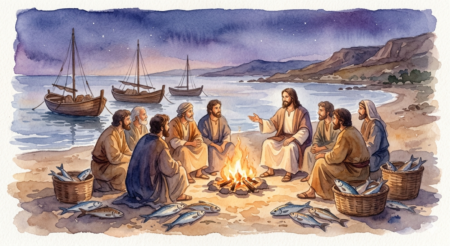
Jesus, after His resurrection with new body.
He’s with disciples. eating a meal of fish, prepared on the fire.
Several wooden fishing boats are anchored in the calm water of the sea behind them, and rugged hills rise in the distance under a starlit sky.
So – what do you believe?
Which image represents your view/beliefs on what “Easter” is about? If you’re a Christian, all three are open to you. We don’t dictate what others believe. At least, those of us who understand what Jesus said, follow His examples, and try to life as He desires, we don’t. God didn’t force us to believe, and we shouldn’t force anyone to believe either.
For Christians
For those who claim to be Christians, the question is different.
Do you believe? For us, the question can still be which one of the three we believe. But here’s the thing. The Bible, and Jesus’ life, doesn’t leave us any flexibility on which one we should believe. It’s option 3 – the full resurrection with a new body. I mean – spirits don’t eat fish.
And that leads is, Christians to two final questions.
1. Do we – or do we not – believe the words that the Bible says are trustworthy and true?
The Bible tells us, in no uncertain terms, that resurrection is a new body in a new “world” – there’s a new Jerusalem, a new Heaven and a new Earth. Things made right – the way they were before the fall. That’s not spiritual.
2. If we don’t believe that, why not?
Why do we want less than what’s offered by God?
Do we not believe God can deliver on His promise?
Keep in mind, there was a time when the “Good news” of the Gospel was “Good News!”
It often feels like that’s not the case anymore. The problem isn’t that God took part of the offer off the table. Rather, I believe, we either don’t really know what’s offered, we don’t understand it, or we no longer have faith that He can deliver.
I totally get that. There was a time, a rather lengthy time, when I was sure it either wasn’t offered to me or it just wasn’t true. I mean, sometimes life just sucks. But think about this – life now is so much better than it was back then. They wanted something better. They saw it happen. And they went for it.
I remember when I was a kid in grade school. I heard the verse below, especially the part about fathers:
Ask, Seek, Knock – Matthew
7:7-11 pp — Lk 11:9-13
Mt 7:7 “Ask and it will be given to you; seek and you will find; knock and the door will be opened to you. 8 For everyone who asks receives; he who seeks finds; and to him who knocks, the door will be opened.
Mt 7:9 “Which of you, if his son asks for bread, will give him a stone? 10 Or if he asks for a fish, will give him a snake? 11 If you, then, though you are evil, know how to give good gifts to your children, how much more will your Father in heaven give good gifts to those who ask him! 12 So in everything, do to others what you would have them do to you, for this sums up the Law and the Prophets.”
I still remember hearing those highlighted words, sitting right next to my parents in a hot church, and thinking – “mine would!” Give me the stone or the snake, that is. I wanted that promised Father so much. Until I didn’t. I looked long and hard for an alternative.
There isn’t one. Now, I have that Father. He’s been with me in the hospital when I nearly died from a staph infection. He was with me while I was treated for radiation after surgery to remove a cancerous prostate didn’t get all of it. That includes the time in the tube getting one of my 38 times in the tube, when it was so peaceful that I asked the tech if I could go back in.
I can sum it up my saying that life didn’t get any easier. Harder in many ways. And yet, it’s so much better with “that Father”.
I want to believe the offer in the Bible is true. I do believe it. Even my own life points to the promises in it from Jesus are true. How can I not believe?
What about you? There are so many variations of that question. But I’m convinced the first one to answer, for ourselves if not for anyone else, is: “What do I want to believe?” Then don’t hold back. Don’t settle for less. Go for everything God offers to those who believe enough in His Son that it changes our lives. And it will change. Not easier – but so much better.
Why settle for anything less?
Footnotes:
- 1Morris, L. L. (1996). Resurrection. In D. R. W. Wood, I. H. Marshall, A. R. Millard, J. I. Packer, & D. J. Wiseman (Eds.), New Bible dictionary (3rd ed., p. 1010). Leicester, England; Downers Grove, IL: InterVarsity Press.
- 2Burns, J. L. (2016). Resurrection. In J. D. Barry, D. Bomar, D. R. Brown, R. Klippenstein, D. Mangum, C. Sinclair Wolcott, … W. Widder (Eds.), The Lexham Bible Dictionary. Bellingham, WA: Lexham Press.
Discover more from Which god can save?
Subscribe to get the latest posts sent to your email.