
True believer
- _____________
-
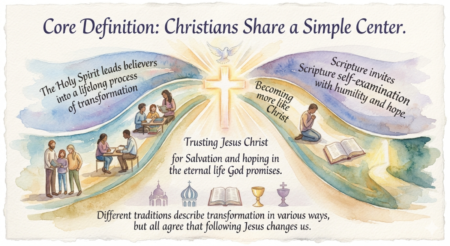
Core definition: Christians share a simple center: trusting Jesus Christ for salvation and hoping in the eternal life God promises. From that center, the Holy Spirit leads believers into a lifelong process of transformation – becoming more like Christ – and Scripture invites them to examine their lives with humility and hope.
Different traditions describe transformation and self‑examination in various ways, but all agree that following Jesus changes us.
John 3:16 is often used as the go-to verse for Christians.
Jn 3:16 “For God so loved the world that he gave his one and only Son, that whoever believes in him shall not perish but have eternal life.
There’s so much more to living as a Christian. For instance, even “believes” is so much more than what we generally think it means today. It means to believe in and to believe, to the point where that belief is so strong that it changes our lives. That’s the beginning of the transformation that’s very much a part of living a Christian life.
But beyond that, the various denominations have such varied beliefs about what needs to be done, how to do it, which things are most important, and on and on.
My sites, in general, try to go into those things, explain some of the differences, and the impact they have on our view of God. I also go into the original Hebrew or Greek, the culture of the time, various theology/denominational view, to give you assistance in “owning your own faith”. These things really can affect our relationship with Jesus and our journey with Him.
One thing to remember, throughout the Bible, we learn the importance of what God sees in our hearts. So, as we go on our Christian walk, that’s important to remember, to keep an eye on, and to even ask God – how am I doing, and what do I need to work on?
Below is a Question and Answer sequence I did with the Faithlife/LOGOS AI agent on the topic of “What makes someone a true believer?”
It gets into the complexities of Christianity, as we move into different denominations. All of them agree on the core above. But then, for various reasons, people disagree on nearly everything else. My sites try to address those issues in individual articles.
A “definiton” of a true believer
❓ Can you give me a description of what makes someone a “true believer”?
✏️ The answer is very long and complex. It’s amazing that people in Jesus’ time could hear so much less, understand so much more, and recognize the Good News. It’s more amazing when you realize it’s largely the poor and uneducated who “got it”. Shepherds. Fishermen. The outcasts and the sinners. And now today – well, read on and see what it’s come to.
🤖✨ A true believer emerges from several interconnected dimensions that theological traditions have consistently emphasized.
At the foundation lies doctrinal conviction – the New Testament test of authentic Christianity centers on believing that Jesus is the Son of God incarnate and the Christ and Lord1. This isn’t merely intellectual assent but a confession paired with heartfelt conviction that Jesus is Lord and that God raised Him from the dead2. Faith in Jesus as Savior, rather than adherence to rules or good works, constitutes the entry point2.
Beyond initial conversion, authentic faith involves an internalized relationship with God. A true Christian possesses a ruling sense of God’s presence within – a faith that lives in the awareness of His presence not merely externally but in one’s innermost heart and conscience3. This manifests as a conscience illuminated by God, habitually realizing that all thoughts, moral impulses, motives, and wishes lie open before Almighty God3. Rather than compartmentalizing life or maintaining private spaces where God is excluded, the true Christian enthrones Christ in conscience, referring to Him as sovereign authority without reasoning or self-defense3.
The evidence of genuine belief appears in both conviction and transformation. A true Christian possesses God’s Holy Spirit dwelling within2, and this faith displays itself through both belief and action – a true Christian demonstrates faith through how he lives2. When someone commits to Christ, they inevitably commit to certain doctrines about Him, and this theological understanding must mature and develop rather than remain static1.
Ultimately, a true believer is one who has personally received Jesus Christ as Savior, trusts in His death and resurrection alone for forgiveness, possesses the indwelling Holy Spirit, and exhibits life transformation consistent with that faith2.
1 Amos, “Theology and Reunion,” The Churchman (1954), 72–73.
2 Got Questions Ministries, Got Questions? Bible Questions Answered (Bellingham, WA: Logos Bible Software, 2002–2013). [See here, here, here, here, here, here.]
3 John Henry Newman, Parochial and Plain Sermons (London; Oxford; Cambridge: Rivingtons, 1868), 225–227.
What do we think identifies someone who claims to be Christian – but really isn’t?
✏️ Of course, some/many will claim to be Christian, but really aren’t. Some may think they are – but aren’t. How might we be able to tell the difference?
❓ For someone who claims they are Christian, in order for them to hear from Jesus, “I never knew you”, do scholars and church leaders consider that is even one of those dimensions is not the case – does it take failure to have all of them – or is it a case by case basis, and depends on what Jesus knows about their heart?
🤖✨ Scholars and church leaders present a more nuanced picture than a simple “all-or-nothing” framework. The disagreement centers on whether the pronouncement “I never knew you” indicates final damnation or something more specific about the nature of the relationship claimed.
The core issue involves whether those hearing this declaration never possessed a genuine personal relationship with Christ – they failed to acknowledge His redemption and their need for it, never coming to Him for salvation in the first place.1 From this perspective, the problem isn’t merely a failure in one dimension but rather the absence of the foundational relationship itself.
However, a significant interpretive tension emerges. Some scholars argue that obedience functions as the “essential characteristic” of true believers, while others contend that faith in Christ should hold this position.2 This disagreement matters because one view acknowledges that saved people can exist “in” the kingdom while practicing lawlessness – these are “carnal Christians” whose moral lives contradict their profession.2
Rather than requiring perfection across all dimensions, the search results suggest the issue is one of trajectory and allegiance. While no one enters the kingdom through obedience alone, equally no one enters without it – God’s grace inevitably produces obedience in a person’s life.3 The false professors in Matthew 7 aren’t condemned for occasional stumbling but for building their entire spiritual identity on external works while remaining strangers to Christ personally.
“I never knew you” functions as a “formula of renunciation” meaning “I never recognized you as one of my own,”4 suggesting the verdict reflects the actual state of the relationship throughout, not a sudden discovery. The heart’s orientation – whether genuinely submitted to Christ or merely performing for reputation – appears to be what Jesus ultimately knows and judges.
1 Leadership Ministries Worldwide, The Gospel according to Matthew: Chapters 1:1–16:12, The Preacher’s Outline & Sermon Bible (Chattanooga, TN: Leadership Ministries Worldwide, 2004), 1:168.
2 Joseph Dillow, “I Never Knew You – Matthew 7,” in A Defense of Free Grace Theology: With Respect to Saving Faith, Perseverance, and Assurance, ed. Fred Chay (Houston, TX: Grace Theology Press, 2017), 438 – 439.
3 Danny Akin, Exalting Jesus in the Sermon on the Mount (Nashville, TN: Holman Bible Publishers, 2019), 145.
4 W. D. Davies and Dale C. Allison Jr., A Critical and Exegetical Commentary on the Gospel according to Saint Matthew, International Critical Commentary (London; New York: T&T Clark International, 2004), 1:717.
Even this isn’t easy. Differences in something that seems to be pretty important prevent a simple answer.
That reply makes sense.
✏️ Yeah – it makes sense, up to a point. Sadly, after that – it still makes sense, but only because it’s disagreement! I wonder, what does God think of what we’ve done to His Good News message?
❓ That makes sense, given that none of us will be 100% successful in any dimension, let alone all.
🤖✨ You’ve identified the crucial theological insight that bridges the apparent tension. The search results clarify that the distinction isn’t about achieving perfection but about the direction and nature of one’s spiritual life.
At conversion, a holy principle is imparted, but the old sinful nature remains unchanged and equally active1. No believer receives enough grace in this life to become sinless, and all fall into sin repeatedly, yet they do not become wholly corrupt as the unregenerate do, nor do they sin with their whole heart1. This establishes that partial failure across all dimensions is the normal Christian experience.
The critical distinction lies in what scholars call the “trajectory” of the believer’s life. A key difference between believers and unbelievers emerges: if the believer falls into sin, they do not remain there, but eventually turn again through God’s seed within them2. The believer is never wholly free from sin in this life, and the conflict is normal – yet there is “a total difference between surviving sin and reigning sin”3.
True believers are transformed at conversion, and their lives manifest their Lord’s presence and power; there is no such thing as a fundamentally carnal, incorrigibly disobedient Christian who refuses to surrender to Christ as Lord4. The verdict “I never knew you” applies to those whose lives show no evidence of genuine transformation – not those struggling imperfectly but genuinely pursuing Christ.
So it’s not case-by-case based on hidden knowledge, but rather observable over time: does the person’s overall trajectory show movement toward Christ or away from Him?
1 Arthur Walkington Pink, Eternal Security (Bellingham, WA: Logos Bible Software, 2005), 29.
2 Philip Edgcumbe Hughes, Theology of the English Reformers, ed. Marion Hughes (Eugene, OR: Wipf & Stock, 1997), 109.
3 Carl F. H. Henry, Christian Personal Ethics (Grand Rapids, MI: Baker Book House, 1977), 468.
4 John MacArthur, “Afterword,” in No Quick Fix: Where Higher Life Theology Came From, What It Is, and Why It’s Harmful (Bellingham, WA: Lexham Press, 2017), 104.
Do denominations determine whether obedience or faith is primary?
❓ Is there a denominational emphasis on whether obedience or faith is the primary?
🤖✨ Yes, denominational traditions emphasize these priorities quite differently, reflecting deeper theological commitments about how salvation works.
Pietists and Puritans stressed that while justification comes through grace and faith alone, “the verification of faith lies in its ethical achievements.”1 Reformed theologians embrace “faith and obedience” together, maintaining respect for God’s law even while affirming salvation by faith in the gospel.1 This Reformed approach sees obedience not as earning salvation but as its inevitable fruit – the two cannot be separated.
Wesleyans differ by viewing grace optimistically, arguing that salvation must address humanity’s fundamental problem – sin itself – rather than leaving believers perpetually caught between sinner and saint.2 Wesleyans contend that if God calls us holy, we must actually be made holy, capable of holy works through God’s Spirit.2 This tradition emphasizes transformation more directly.
The broader theological divide centers on agency and assurance. Calvinists believe God alone ensures that the saved will maintain active faith, while Arminians hold that once saved, people must choose to persevere in faith – and can resist God and abandon it.3 This distinction shapes whether obedience flows from God’s guarantee or from human responsibility.
However, good Christian leaders across these positions focus on living faithfully, and both camps question the salvation of those without transformed lives – people who don’t grow in faith or genuinely struggle with temptation.3 The denominational emphasis differs on why obedience matters, but agreement exists that authentic faith produces it.
1 Donald G. Bloesch, The Holy Spirit: Works & Gifts (Downers Grove, IL: IVP Academic, 2000), 32–33.
2 Richard K. Eckley, “Holiness in Other Christian Traditions,” in Be Holy: God’s Invitation to Understand, Declare, and Experience Holiness, ed. Joseph Coleson (Indianapolis, IN: Wesleyan Publishing House, 2008), 94.
3 Bobby Harrington and Daniel McCoy, Real Life Theology: Fuel for Effective and Faithful Disciple Making (renew.org, 2021), 694.
Again. Complications. As I said, this is a very complex definition.
I feel like it boils down to something the various denominations don’t want to agree on – or just can’t. What’s in our hearts? It really shouldn’t be that hard.
Discover more from Which god can save?
Subscribe to get the latest posts sent to your email.