
We have faith that our team will win. And faith that it will rain. Even that we can pick a winning lottery number. In all those cases, faith requires taking a risk on something you can’t see. Faith requires trust. So why do we have so much trouble with trusting God?
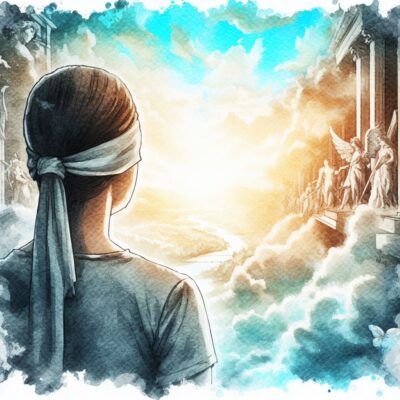
We read and hear so many things about faith. Some of it seems impossible. For instance:
Faith is to believe what we do not see, and the reward of this faith is to see what we believe.
At best, that sounds like circular logic. How can it possibly be true?
My favorite team, whether it be hockey, football, whatever, isn’t going to win just because I have faith that they will. Sports just doesn’t work that way. Nothing works that way in life.
And of course, that’s the key. Nothing works that way in life. Faith in God isn’t entirely about this life. It is about getting beyond the end of our nose. Beyond the next five minutes. Even beyond this life. Faith requires trust in a God we can’t literally see, and for a life that won’t come until after this one ends.
Although, I have to add, kind of, sort of. There is evidence of true faith in God, even in this life. Evidence that’s a pale shadow of what’s to come. And so, while the reward begins in this life, its ultimate fulfillment is in the next life. That also means we can begin to trust God in this life, if we understand something about Him, and if we pay attention to the promises for this life that will lead us to trust in His promises for the next life.
We can call ourselves risk takers, excitement seekers, and all sorts of other amazing adjectives. But when it comes to God and the greatest “reward” ever – how often are we really ready to take the risk? To have faith? And to have the trust that’s needed as a foundation for our faith?
Summary
Discusses the relationship between faith and trust, emphasizing that faith involves taking a risk on something unseen and requires trust in God.
Understanding Faith: Explores the concept of faith beyond just believing, suggesting that true faith transforms lives and aligns with the teachings of Jesus and the Bible.
Biblical Context: Examines faith in the context of biblical figures and verses, such as Hebrews 11:1 and Romans 8:24, to illustrate the nature of faith as described in the scriptures.
Choice and Consequence presents the idea that faith, or lack thereof, in God will lead to different outcomes, and it encourages readers to consider the implications of their beliefs.
Encourages a deeper reflection on the meaning of faith and its impact on one’s life and afterlife.
Faith requires trust? I thought faith required believing.
So many people are familiar with John 3:16
John 3:16 – John
…
Jn 3:16 “For God so loved the world that he gave his one and only Son, that whoever believes in him shall not perish but have eternal life.
…

Are we supposed to Believe God, Believe in God or Follow God?
Are we supposed to Believe God, Believe in God or Follow God? Are those three sets of words all different? Or do they all mean the same thing? Well, it depends. When were you born? What culture do you live in/come from? Most important, are you willing to learn what they meant when they were said? We need to look at what they meant when they were said, in order to understand what they mean today.
Isn’t that all we need? To believe this?
Well, as I’ve written so many times before, no. It’s not “all” we need.
Not unless by “believe” we mean that we believe it so much that we change our life because of what Jesus said, did, and commanded.
Not unless our lives are transformed by our beliefs.
And that’s our belief in what Jesus and the Bible truly say, not what we hope or think they say.
It’s easy to say we believe something.
It’s orders of magnitude more difficult to live it out.
Fortunately, if we do trust God, He does help.
The problem of faith – why faith requires trust
I don’t normally pull verses out of context. But then, it’s something that happens, probably way too often. Anyway, here are two. Just taking these two with nothing else at all leads to a problem, as we’ll see.
Heb 11:1 Now faith is being sure of what we hope for and certain of what we do not see.
Ro 8:24 For in this hope we were saved. But hope that is seen is no hope at all. Who hopes for what he already has? 25 But if we hope for what we do not yet have, we wait for it patiently.
Do you see what I mean? Isn’t that circular logic?
Or, is it a leap of faith that leads to the truth? Is it the only way to the truth?
Or, is it always true, no matter what we think?
Back to reality. Think about those three options: 1) circular logic, 2) a leap of faith, 3) nothing but the truth.
Which one do you think it is?
We do have some choices here. Choices based on trust. Or a lack of trust. Let’s check them out.
No trust – reject God and the Bible
If we reject God and the Bible, the question becomes moot. Why? Because the assumptions are also rejected. If that’s where you’re at, and you have no desire to examine further, God will let you do just that. It’s your choice and your decision.
But here’s the thing about that choice. A choice to reject God doesn’t change the truth of what you read above.
Huh? If you do not believe in God, then do you not have faith that He doesn’t exist? Got it? There’s faith on your part, either way! And then your reward for your faith – whichever way that faith goes – that faith will be appropriately rewarded. Here’s how:
- If you reject the Bible and there is a Heaven, you won’t be there, because you have faith that it doesn’t exist. Therefore, you won’t see it even if it does exist. In that way, even after you die, you get what you believe to be true. In other words, in effect, it will be true “for you”, because you won’t be there. It’s an interesting conclusion for people who think that there is no absolute truth. Instead, they believe that truth is based on what’s true for them.
- If you reject the Bible there is no Heaven, you won’t be there. Ironically, it’ll be because your faith that Heaven doesn’t exist will turn out to have been true.
- However, having said all that, you’ll also never know the truth about Heaven. Either way you get what you believed to be true. You’ll just never know that in the first case, you were wrong. In other words, you will, in one sense, be happy because either way you’ll think you were right.
We see then, that rejecting God and the Bible leads to a belief that there was no risk involved.
Remember the title: Faith requires trust: taking a risk on something we can’t see.
But here we see the odd case of something that could be conceived of as “Faith with no trust has no risk”. Of course, that’s a fallacy. But in the end, literally, the person who doesn’t trust God or the Bible, but does have faith that God doesn’t exist – they won’t be in Heaven and will believe they were right all along!
These people will never know that they pre-determined the outcome, regardless of reality. That’s one way of concluding no risk was involved.
But we’ll see below, it was the choice with the biggest risk, even if it’s never perceived.
Trust – believe God and the Bible
Now, let’s take a look at someone who does have faith in God and the Bible, believing both are true. Yes, there’s a risk here as well. But it’s an entirely different risk.
- If we accept the Bible and there is a Heaven, we will be there because our faith led us to believe that something we couldn’t see. That God does exist. That His Word is true. And Heaven does indeed exist. Therefore, we get what we believed to be true. Although, the Bible tells us that what actually does exist will be far greater than anything we could ever imagine.
- If we accept the Bible, but there is no Heaven, then our faith led us down a path that turned out not to be true. Therefore, we won’t get what we thought to be true.
- However, while the risks in the first group are known – because in that group the Bible is true – in this case we have no idea what happens. We don’t even know if there’s a next life. The upside for believing is something better than we could imagine. The downside is totally unknown. It makes me wonder, how come fear of the unknown doesn’t drive more people to at least want to believe in God and the possibility of Heaven. But then, maybe that’s why Satan is called the father of lies. Satan convinces people that the unknown is better than the best thing ever.
OK, we just looked at the scenarios and possible outcomes from a purely logical point of view.
Now, let’s turn to the Bible. If you don’t believe the Bible’s true – that’s OK. I just ask you to go through the exercise. You really have little to lose. Just a bit of your time. But if it changes your mind, even a little bit, the upside’s worth way more than the time it took to read it.
A biblical look at why faith requires trust: taking a risk on something we can’t see
Old Testament heroes taking a risk with their faith
Yes, Christianity needs a New Covenant/New Testament faith. But we shouldn’t/can’t ignore the Old Testament. The Old Testament tells us a lot about what’s to come. But it also allows us to look back and see where our beliefs came from. For instance, while Jesus is the foundation for our beliefs, the Old Testament tells us a lot about the future coming of Jesus for the people of that time.
The Book of Hebrews: By Faith
Heb 11:1 Now faith is being sure of what we hope for and certain of what we do not see.
The book of Hebrews was written for Jewish people who were converting to what was then known as “The Way”, and today known as Christianity. Let’s look at the passage from which our first verse on faith (above) was taken.
By Faith – Hebrews
Heb 11:1 Now faith is being sure of what we hope for and certain of what we do not see. 2 This is what the ancients were commended for.
Verse 1 is part of the basis for everything we just read. Faith requires trust – and they had that trust.
Verse 2 begins to make the connection between the Old Testament heroes and us today.
Faith wins God’s approval (11:2)
By exercising this kind of faith, the men of old gained that which matters most, the warm commendation of God. These ‘elders’ (it is the same word as that used in the opening sentence of the letter) received the word of God and in different generations made their own response to its message, thus receiving divine approval. Without this kind of faith man cannot please God (11:6) nor have the satisfaction of knowing that his life has the divine favour. For the Christian, pleasing God is of the greatest possible importance. He does not set his heart on gaining human approval; that can be dangerous. He longs that at this present moment he is earning God’s approval and that in the end God will express it. 1Brown, R. (1988). The message of Hebrews: Christ above all (p. 198). InterVarsity Press.
🗝️ Key Insight
My first thought about “Faith wins God’s approval” is that it was somehow giving a wrong impression. As if somehow, we could actually “win” anything from God. After thinking about it for a moment, I realized my impression wasn’t correct. But still, if I thought that, maybe someone else will too.
So, here’s the thing about “winning” God’s approval. Remembering that this is actually New Testament writing to what were Old Covenant Jewish people, we should keep in mind the kinds of things Paul wrote about. He used things like the analogy of running a race, where all can win.
One of many examples of faith from Hebrews 11
By the way, for many of the people listed in Hebrews 11, The Law wasn’t given yet. So, it’s not like they even had God-given standards (laws) to try to meet. But they did hear from God. And they had the faith, even if it wasn’t immediate, to do what He said.
If anything, today, we have so much more. Part of what we have is the writings on their faith. And yet, we still have so much trouble.
Going through the remainder of the people in Hebrews 11 would be overwhelming here, so let’s look at just one – Noah. The flood is known by so many people, even outside of Christianity and Judaism that he’s the obvious choice,
…
Heb 11:7 By faith Noah, when warned about things not yet seen, in holy fear built an ark to save his family.
…
For those who might not know/remember the details, here’s the intro passage to the whole flood scenario.
The Flood – Genesis
…
Ge 6:9 This is the account of Noah.
Noah was a righteous man, blameless among the people of his time, and he walked with God. 10 Noah had three sons: Shem, Ham and Japheth.
Ge 6:11 Now the earth was corrupt in God’s sight and was full of violence. 12 God saw how corrupt the earth had become, for all the people on earth had corrupted their ways. 13 So God said to Noah, “I am going to put an end to all people, for the earth is filled with violence because of them. I am surely going to destroy both them and the earth. 14 So make yourself an ark of cypress wood; make rooms in it and coat it with pitch inside and out. 15 This is how you are to build it: The ark is to be 450 feet long, 75 feet wide and 45 feet high. 16 Make a roof for it and finish the ark to within 18 inches of the top. Put a door in the side of the ark and make lower, middle and upper decks. 17 I am going to bring floodwaters on the earth to destroy all life under the heavens, every creature that has the breath of life in it. Everything on earth will perish. 18 But I will establish my covenant with you, and you will enter the ark-you and your sons and your wife and your sons’ wives with you. 19 You are to bring into the ark two of all living creatures, male and female, to keep them alive with you. 20 Two of every kind of bird, of every kind of animal and of every kind of creature that moves along the ground will come to you to be kept alive. 21 You are to take every kind of food that is to be eaten and store it away as food for you and for them.”
Ge 6:22 Noah did everything just as God commanded him.
Ge 7:1 The LORD then said to Noah, “Go into the ark, you and your whole family, because I have found you righteous in this generation. 2 Take with you seven of every kind of clean animal, a male and its mate, and two of every kind of unclean animal, a male and its mate, 3 and also seven of every kind of bird, male and female, to keep their various kinds alive throughout the earth. 4 Seven days from now I will send rain on the earth for forty days and forty nights, and I will wipe from the face of the earth every living creature I have made. ”
Ge 7:5 And Noah did all that the LORD commanded him.
…
Can you even imagine all the people laughing at Noah? He’d be trending like crazy on social media today. Why? Because he had faith in God. And he trusted God. He’d be an example in Wikipedia under “faith requires trust”.
And then, after the flood, we read:
God’s Covenant With Noah – Genesis
Ge 9:1 Then God blessed Noah and his sons, saying to them, “Be fruitful and increase in number and fill the earth. 2 The fear and dread of you will fall upon all the beasts of the earth and all the birds of the air, upon every creature that moves along the ground, and upon all the fish of the sea; they are given into your hands. 3 Everything that lives and moves will be food for you. Just as I gave you the green plants, I now give you everything.
Ge 9:4 “But you must not eat meat that has its lifeblood still in it. 5 And for your lifeblood I will surely demand an accounting. I will demand an accounting from every animal. And from each man, too, I will demand an accounting for the life of his fellow man.
Ge 9:6 “Whoever sheds the blood of man,
by man shall his blood be shed;
for in the image of God
has God made man.
Ge 9:7 As for you, be fruitful and increase in number; multiply on the earth and increase upon it.”
Ge 9:8 Then God said to Noah and to his sons with him: 9 “I now establish my covenant with you and with your descendants after you 10 and with every living creature that was with you—the birds, the livestock and all the wild animals, all those that came out of the ark with you—every living creature on earth. 11 I establish my covenant with you: Never again will all life be cut off by the waters of a flood; never again will there be a flood to destroy the earth.”
Ge 9:12 And God said, “This is the sign of the covenant I am making between me and you and every living creature with you, a covenant for all generations to come: 13 I have set my rainbow in the clouds, and it will be the sign of the covenant between me and the earth. 14 Whenever I bring clouds over the earth and the rainbow appears in the clouds, 15 I will remember my covenant between me and you and all living creatures of every kind. Never again will the waters become a flood to destroy all life. 16 Whenever the rainbow appears in the clouds, I will see it and remember the everlasting covenant between God and all living creatures of every kind on the earth.”
Ge 9:17 So God said to Noah, “This is the sign of the covenant I have established between me and all life on the earth.”
More Old Testament heroes taking a risk with their faith
As I said, I’m not going through the complete passage from Hebrews. It would make this way too long. But I do believe the point is made.
And yet, I also don’t want to leave you wondering – what did it say? So, if you’d like to see how this theme unfolds across the whole chapter, here’s the full passage from Hebrews 11.
By Faith – Hebrews
Heb 11:1 Now faith is being sure of what we hope for and certain of what we do not see. 2 This is what the ancients were commended for.
Heb 11:3 By faith we understand that the universe was formed at God’s command, so that what is seen was not made out of what was visible.
Heb 11:4 By faith Abel offered God a better sacrifice than Cain did. By faith he was commended as a righteous man, when God spoke well of his offerings. And by faith he still speaks, even though he is dead.
Heb 11:5 By faith Enoch was taken from this life, so that he did not experience death; he could not be found, because God had taken him away. For before he was taken, he was commended as one who pleased God. 6 And without faith it is impossible to please God, because anyone who comes to him must believe that he exists and that he rewards those who earnestly seek him.
Heb 11:7 By faith Noah, when warned about things not yet seen, in holy fear built an ark to save his family. By his faith he condemned the world and became heir of the righteousness that comes by faith.
Heb 11:8 By faith Abraham, when called to go to a place he would later receive as his inheritance, obeyed and went, even though he did not know where he was going. 9 By faith he made his home in the promised land like a stranger in a foreign country; he lived in tents, as did Isaac and Jacob, who were heirs with him of the same promise. 10 For he was looking forward to the city with foundations, whose architect and builder is God.
Heb 11:11 By faith Abraham, even though he was past age-and Sarah herself was barren-was enabled to become a father because he considered him faithful who had made the promise. 12 And so from this one man, and he as good as dead, came descendants as numerous as the stars in the sky and as countless as the sand on the seashore.
Heb 11:13 All these people were still living by faith when they died. They did not receive the things promised; they only saw them and welcomed them from a distance. And they admitted that they were aliens and strangers on earth. 14 People who say such things show that they are looking for a country of their own. 15 If they had been thinking of the country they had left, they would have had opportunity to return. 16 Instead, they were longing for a better country-a heavenly one. Therefore God is not ashamed to be called their God, for he has prepared a city for them.
Heb 11:17 By faith Abraham, when God tested him, offered Isaac as a sacrifice. He who had received the promises was about to sacrifice his one and only son, 18 even though God had said to him, “It is through Isaac that your offspring will be reckoned.” 19 Abraham reasoned that God could raise the dead, and figuratively speaking, he did receive Isaac back from death.
Heb 11:20 By faith Isaac blessed Jacob and Esau in regard to their future.
Heb 11:21 By faith Jacob, when he was dying, blessed each of Joseph’s sons, and worshiped as he leaned on the top of his staff.
Heb 11:22 By faith Joseph, when his end was near, spoke about the exodus of the Israelites from Egypt and gave instructions about his bones.
Heb 11:23 By faith Moses’ parents hid him for three months after he was born, because they saw he was no ordinary child, and they were not afraid of the king’s edict.
Heb 11:24 By faith Moses, when he had grown up, refused to be known as the son of Pharaoh’s daughter. 25 He chose to be mistreated along with the people of God rather than to enjoy the pleasures of sin for a short time. 26 He regarded disgrace for the sake of Christ as of greater value than the treasures of Egypt, because he was looking ahead to his reward. 27 By faith he left Egypt, not fearing the king’s anger; he persevered because he saw him who is invisible. 28 By faith he kept the Passover and the sprinkling of blood, so that the destroyer of the firstborn would not touch the firstborn of Israel.
Heb 11:29 By faith the people passed through the Red Sea as on dry land; but when the Egyptians tried to do so, they were drowned.
Heb 11:30 By faith the walls of Jericho fell, after the people had marched around them for seven days.
Heb 11:31 By faith the prostitute Rahab, because she welcomed the spies, was not killed with those who were disobedient.
Heb 11:32 And what more shall I say? I do not have time to tell about Gideon, Barak, Samson, Jephthah, David, Samuel and the prophets, 33 who through faith conquered kingdoms, administered justice, and gained what was promised; who shut the mouths of lions, 34 quenched the fury of the flames, and escaped the edge of the sword; whose weakness was turned to strength; and who became powerful in battle and routed foreign armies. 35 Women received back their dead, raised to life again. Others were tortured and refused to be released, so that they might gain a better resurrection. 36 Some faced jeers and flogging, while still others were chained and put in prison. 37 They were stoned; they were sawed in two; they were put to death by the sword. They went about in sheepskins and goatskins, destitute, persecuted and mistreated- 38 the world was not worthy of them. They wandered in deserts and mountains, and in caves and holes in the ground.
Heb 11:39 These were all commended for their faith, yet none of them received what had been promised. 40 God had planned something better for us so that only together with us would they be made perfect.
There is one more point I do want to make though. It’s about the last verse:
Heb 11:39 These were all commended for their faith, yet none of them received what had been promised. 40 God had planned something better for us so that only together with us would they be made perfect.
Why is it, with all that we have today, we seem to have a harder time with our faith than they did back then?
The Book of Romans – Future Glory
Even the NIV title for the next passage maybe tells us why our faith and trust in God is hard to come by. “Future Glory”. And that’s future as in the next life.
At least, that’s how we look at it. Over the past ten years or so, I’ve come to understand and believe that view is incomplete.
Let’s take a look at the passage and see how it fits in with “Faith requires trust: taking a risk on something we can’t see”, as well as why I believe we tend to shortchange what Paul wrote and what God promised us.
Here’s the verse that was singled out at the beginning.
Ro 8:24 For in this hope we were saved. But hope that is seen is no hope at all. Who hopes for what he already has? 25 But if we hope for what we do not yet have, we wait for it patiently.
Paul, in Romans
And now, the full passage.
Future Glory – Romans
Ro 8:18 I consider that our present sufferings are not worth comparing with the glory that will be revealed in us. 19 The creation waits in eager expectation for the sons of God to be revealed. 20 For the creation was subjected to frustration, not by its own choice, but by the will of the one who subjected it, in hope 21 that the creation itself will be liberated from its bondage to decay and brought into the glorious freedom of the children of God.
OK – everything is messed up right now because of The Fall. Not only for us, but for everything in creation. And all of creation is waiting for things to be right.
Ro 8:22 We know that the whole creation has been groaning as in the pains of childbirth right up to the present time. 23 Not only so, but we ourselves, who have the firstfruits of the Spirit, groan inwardly as we wait eagerly for our adoption as sons, the redemption of our bodies. 24 For in this hope we were saved. But hope that is seen is no hope at all. Who hopes for what he already has? 25 But if we hope for what we do not yet have, we wait for it patiently.
This part shows a portion of what we’re waiting for. Then it launches into a short piece of logic.
Yes, we do “hope” for the things God promised. It’s called hope for more than one reason. One of them is that we don’t yet have what’s promised. We hope we will get it. But in a perfectly logical sense, once we do have it – it’s not hope for the future anymore – it’s present reality.
But then, there’s also the part about “we wait for it patiently”.
There’s a level of confidence attached to waiting for something with patience. It’s more than the normal kind of hope we ususally talk about. For instance, when you’re a little kid and hope you get a dog, or a pony for Christmas. Or when you hope for a car on your 16th birthday. In both cases, most of us know the chances of u getting any of those things are slim to none. And, as the saying goes, Slim’s not home. It’s not going to happen. But we still hope. That’s not the kind of hope Paul wrote about.
Ro 8:26 In the same way, the Spirit helps us in our weakness. We do not know what we ought to pray for, but the Spirit himself intercedes for us with groans that words cannot express. 27 And he who searches our hearts knows the mind of the Spirit, because the Spirit intercedes for the saints in accordance with God’s will.
There’s something implied in these verses, We do believe in the Holy Spirit if we do those things. After all, if we don’t believe in God, why are we looking to His Spirit to intercede for us?
However, it’s even deeper than that. We have that level of confidence. And if we do try to follow Jesus, and if we actually pay attention to the Holy Spirit, we also have something else. If we live by the Spirit, we can have (especially see the underlined portion):
Life by the Spirit – Galatians
Gal 5:16 So I say, live by the Spirit, and you will not gratify the desires of the sinful nature. 17 For the sinful nature desires what is contrary to the Spirit, and the Spirit what is contrary to the sinful nature. They are in conflict with each other, so that you do not do what you want. 18 But if you are led by the Spirit, you are not under law.
Gal 5:19 The acts of the sinful nature are obvious: sexual immorality, impurity and debauchery; 20 idolatry and witchcraft; hatred, discord, jealousy, fits of rage, selfish ambition, dissensions, factions 21 and envy; drunkenness, orgies, and the like. I warn you, as I did before, that those who live like this will not inherit the kingdom of God.
Gal 5:22 But the fruit of the Spirit is love, joy, peace, patience, kindness, goodness, faithfulness, 23 gentleness and self-control. Against such things there is no law. 24 Those who belong to Christ Jesus have crucified the sinful nature with its passions and desires. 25 Since we live by the Spirit, let us keep in step with the Spirit. 26 Let us not become conceited, provoking and envying each other.
If we don’t pay attention to the Holy Spirit, don’t make prayer a two-way conversation, we may not even realize we have those things!
However, if we do pay attention, then we won’t short-change what Paul wrote. And we won’t miss part of what God promised. Rather, we will begin to feel and experience something of the Kingdom of Heaven right here in this life.
That’s life changing. And it can be real. Now.
Conclusion – Faith requires trust: taking a risk on something we can’t see
Going back to the beginning of this topic, it’s weird, but logical, to think that a “no risk” – guaranteed way to get what you want – is to not believe in God.
But the proposition with the risk is to believe in God.
I guess that’s why it’s called faith. It takes risk to believe in something you can’t see.
And yet, as we learned by the end of this examination of faith and trust, the idea that we have faith in something we can’t see sells God short. Most likely, that’s because we also sell ourselves short. We can’t imagine that God would actually talk to us. If He ever did talk to people, those days are long gone. Just as God is long gone.
But that’s a lie. God does still talk with us. It’s us that don’t listen to God. One day at work, I even heard two people at a humanist club, on rush day, talking to each other as I walked by. One was explaining to the other about why he was late. The other one told him, “Thank God you made it!”. Seriously. Someone who supposedly doesn’t believe in God thanking him that his buddy made it to their table.
We sell God short all the time. Even those of us who believe in Him.
Stop doing that!
It’s not easy. I wish I had put into practice many of the things I know long before I did.
But then, if I did that, I wouldn’t have written much of what I just did. I always say, if I could change anything in my life, I wouldn’t change anything. Not even the worst stuff that happened. Because then I wouldn’t be where I am now. I like where I am. And where I’m going.
Do you remember “joy” (above) from the fruit of the Spirit? A large part of the joy I feel now comes when someone tells me they got something from what I said or what I wrote.
And those things increase both my faith and my trust in God.
Footnotes:
- 1Brown, R. (1988). The message of Hebrews: Christ above all (p. 198). InterVarsity Press. ↩︎
Discover more from Which god can save?
Subscribe to get the latest posts sent to your email.