
For a nation that generally insists on keeping government and religion in their proper lanes, the past few days have exposed a troubling crack in the foundation. According to complaints filed by more than a hundred service members, some U.S. military commanders are telling troops that the emerging conflict with Iran is “all part of God’s plan” and even invoking Armageddon as the frame for what lies ahead.
Most Americans know the phrase “separation of church and state,” even though those exact words never appear in the Constitution. The phrase survives because it points to two commitments that do appear in the text: the government may not establish religion, and individuals must be free to exercise their own. Together, these principles were meant to keep state power from favoring one religion over another – or from forcing any religion on an individual.
👥👥Why This Conversation Matters
The word is on edge at the moment. Many try to frame the attack on Iran as being defensive. As preventing something worse. Keeping Iran from attacking first. The one thing I can see, from both U.S. news and BBC, is that this is put out as a political/military necessity and/or government protecting its people necessity.
What follows is not an attack on anyone’s religion. It is, as far as I can tell from research, an accurate presentation of the general concepts in the religions we’ll look at. However, as with pretty much everything in life, the extremes can make the core beliefs hard to identify.
In any case, whether we go along with someone’s beliefs or not doesn’t change the reality that beliefs do drive people’s worldview and decisions.
And so, the first question is whether this is against the U.S. Constitution? Is this contrary to other countries with similar standards in their core documents? If yes, there truly is reason to be worried about a government, off on a religious mission.
📄❓What does the conversation really say about church and state?
Earlier, I briefly mentioned two parts of the Constitution: 1) No establishment and 2) Free exercise. They’re quite brief and to the point. Remember also, the words “separation of church and state” are nowhere to be found in the constitution or any of the amendments.
What we do have is 1 portion of the first amendment.
No establishment of religion and Free exercise of religion in the first amendment to the Constitution: Congress shall make no law respecting an establishment of religion, or prohibiting the free exercise thereof; or abridging the freedom of speech, or of the press; or the right of the people peaceably to assemble, and to petition the Government for a redress of grievances.
It’s so short.
It essentially says the government can’t establish a religion – which was a concern because so many came to this continent to escape the religions held by the kings and queens in the countries they were escaping from.
It also says the government can’t prohibit the free exercise of religion. Why? for the same reason as the previous segment of the sentence.
Obviously, this is a problem, even at the very highest levels where we see the three Abrahamic religions: Judaism, Christianity, and Islam. But then, when we get into different denominations, sects, etc., it actually gets worse. Remember the breaks from the larger mainstream group at any level of a religion means there’s a difference in belief. A difference large enough to cause a schism. In some cases, differences that people died because of.
Therefore, when the government starts to favor one portion of any religion, it goes against the beliefs of everyone else. That’s exactly what’s happening today.
It’s not at all obvious to most people. We just don’t think about religious wars anymore. We think many things cause war, but not religions.
⚔ 💣🛦Why the Military Context Makes This Especially Serious
When the government gets between an individual citizen and their religious beliefs, that’s one thing. Not that it’s unimportant. It is. But consider a few years back with Covid. In some places, churches were told not to meet in large groups. Some met anyway. Some met on-line. Others met in smaller groups, outdoors. I saw some in the UK rural areas where the pastors, priests and others went around house to house on bicycles. My point is, there are alternatives.
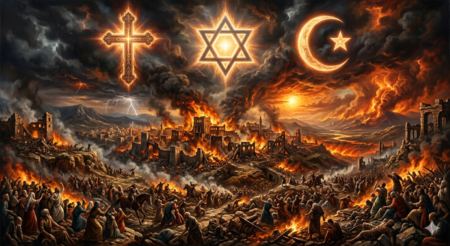
And yet, as the image at the top shows, there’s something else going on. Something that doesn’t come out much at all in most Western countries. That is, until a Huffington Post Headline, “Troops being told to prepare for ‘Armageddon’ in Iran“. It’s something I’ve been researching for a while now. But this is the first time it came across my news feed.
That’s why the military context matters so much. When a commander tells subordinates that war is part of God’s plan, it isn’t a private expression of faith. It’s a religious message delivered through the chain of command-where disagreement can be treated as insubordination, even a felony under military law.
Add to that the scene at the top. It has a Christian Cross, A Jewish Star of David, and an Islamic crescent moon. They each have beliefs around an End Times scenario. Some parts are even the same. However, there are far more differences than similarities. And those differences are vital to its followers. Not one of them agrees with the other two about what the End Times are about, or what the conclusion is!
And that doesn’t even touch those who have no religion, or who have a religion that doesn’t include an Armageddon and an End Times scenario.
That’s why a forced religious concept is so dangerous. We don’t all feel the same way about it. But the government tells soldiers to fight this war, according to my beliefs about the sect of my religion I follow – and I don’t care if yours is different!
And that’s why we see things like the Huffington Post article.
For some U.S. military commanders, the emerging war in Iran is part of a biblical plan to bring about the end of the world as we know it, according to complaints filed by over 100 service members.
Wow.
How’s that for separation of church and state? Sounds like it’s, well, not well followed. How can a nation that espouses separation of church and state reference the Bible and Armageddon?
Think I’m overstating it? Here’s another excerpt.
Mikey Weinstein, founder and president of MRFF, a nonprofit group established 21 years ago that focuses on ensuring constitutional protections for service members, spoke with HuffPost by phone Tuesday morning and illuminated some details of the complaints, which have come from more than three dozen military units situated in at least 30 different military installations.
“We started getting calls in the wee hours of Saturday morning from people saying their commanders were just jubilant about this and trying to tell people, ‘Don’t worry, it’s all part of God’s plan,'” Weinstein said.
Weinstein said the “metric promised” in the Bible’s Book of Revelation is horrifying and should worry everyone.
Indeed, this should worry everyone.
⚡The Core Contradiction
As usual these days, I did some research via AI to go along with everything else. One of them came up with a conclusion I never thought of. And yet – it was right on target.
Thoughts on soldiers’ orders on Armageddon From Copilot AI
- A nation cannot claim to protect both no‑establishment and free‑exercise while allowing government officials-especially military superiors-to speak for God.
- When the state borrows divine authority, it erodes accountability and pressures conscience.
Literally speaking for God might, maybe, be an extreme. However, there’s no getting around the reality that some commanders are telling soldiers under them to essentially fight for God. But worse, to fight for a God they may not believe in, for a version of the God they believe in that’s contrary to their denomination or sect, or countless other contradictions that do lead to an inescapable conclusion.
❌ If you have no beliefs about any kind of God – accept the ones presented by the military and be prepared to die for them.
❌ If you have beliefs about any kind of God, forget about them – accept the ones presented by the military and be prepared to die for them.
❌ If your beliefs about God match the ones espoused by the commanders – if they don’t include dying for them, get with the program and be prepared to die.
✅ If your beliefs about God match the ones espoused by the commanders – and they do include dying – welcome aboard!
There’s just no getting around the alleged church and state problem.
No matter what you want to call it, whether you’re any kind of believer, a non-believer, an I don’t care person – this is government telling you what flavor of a religion – their flavor – you not only must follow but must also be prepared to die for that flavor of religion.
In other words, be prepared to meet a maker you don’t believe in – because the government is making you fight for their version of God.
I don’t know enough about Judaism or Islam to definitively say this is contrary to their scripture.
However, I can tell you, for this government that claims to be some flavor of Christian, there is no – I repeat no – scripture that says this is what God wants from His followers.
This was a starting point …
This post is only the starting point. The relationship between government power and religious belief is tangled, often misunderstood, and rarely discussed with care. In the coming pieces, I’ll take up some of the assumptions that shape this conversation-how we think about faith, freedom, and the role of the state-and try to untangle them one at a time. For now, it’s enough simply to name the contradiction and let it stand.
Discover more from Which god can save?
Subscribe to get the latest posts sent to your email.