
In a recent Supreme Court decision on U.S. Tariffs instituted by one person, the U.S. President, the tariffs were declared unconstitutional. One justice, Bret Kavanaugh, gave a roadmap of how to get around the ruling. Unfortunately, that wasn’t surprising. But there was more. His dissent made it appear that the problem was due to a clerical error. It was about checking the wrong box. It was far more than that. The scenario immediately reminded me of Samuel’s sons, judges, in the Bible. It was those sons that led the people to demand a human King instead of God.
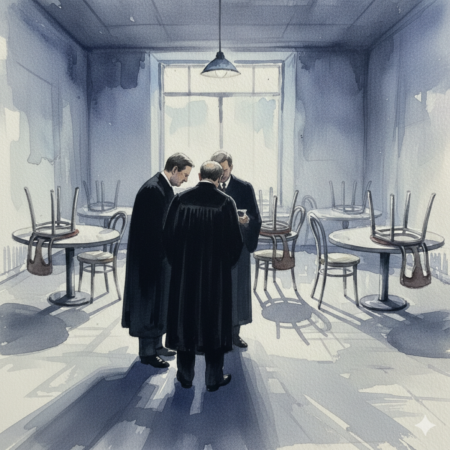
The image at the right is not part of the news. There’s no factual information that points to it taking place. It’s a conceptual representation of what some people likely thought of after this ruling.
It’s also a modern-day visualization of what people in the Old Testament thought of when they demanded a human king. They were essentially being “ruled” by Samuel’s sons, who were the judges at the time.
Before we get into the ruling on tariffs, let’s take a quick look at what happened when Israel asked for a king in 1 Samuel:
Israel Asks for a King 🔍
1Sa 8:1 When Samuel grew old, he appointed his sons as judges for Israel. 2 The name of his firstborn was Joel and the name of his second was Abijah, and they served at Beersheba. 3 But his sons did not walk in his ways. They turned aside after dishonest gain and accepted bribes and perverted justice.
1Sa 8:4 So all the elders of Israel gathered together and came to Samuel at Ramah. 5 They said to him, “You are old, and your sons do not walk in your ways; now appoint a king to lead us, such as all the other nations have.”
1Sa 8:6 But when they said, “Give us a king to lead us,” this displeased Samuel; so he prayed to the LORD. 7 And the LORD told him: “Listen to all that the people are saying to you; it is not you they have rejected, but they have rejected me as their king. 8 As they have done from the day I brought them up out of Egypt until this day, forsaking me and serving other gods, so they are doing to you. 9 Now listen to them; but warn them solemnly and let them know what the king who will reign over them will do.”
1Sa 8:10 Samuel told all the words of the LORD to the people who were asking him for a king. 11 He said, “This is what the king who will reign over you will do: He will take your sons and make them serve with his chariots and horses, and they will run in front of his chariots. 12 Some he will assign to be commanders of thousands and commanders of fifties, and others to plow his ground and reap his harvest, and still others to make weapons of war and equipment for his chariots. 13 He will take your daughters to be perfumers and cooks and bakers. 14 He will take the best of your fields and vineyards and olive groves and give them to his attendants. 15 He will take a tenth of your grain and of your vintage and give it to his officials and attendants. 16 Your menservants and maidservants and the best of your cattle and donkeys he will take for his own use. 17 He will take a tenth of your flocks, and you yourselves will become his slaves. 18 When that day comes, you will cry out for relief from the king you have chosen, and the LORD will not answer you in that day. “
1Sa 8:19 But the people refused to listen to Samuel. “No!” they said. “We want a king over us. 20 Then we will be like all the other nations, with a king to lead us and to go out before us and fight our battles.”
1Sa 8:21 When Samuel heard all that the people said, he repeated it before the LORD. 22 The LORD answered, “Listen to them and give them a king.”
Then Samuel said to the men of Israel, “Everyone go back to his town.”
I included the entire passage so you can see what happened. But the key parts for today are to see:
- what was going on with the judges
- how massive the impact was.
An analysis of Samuel’s sons as judges
Rather than write my own statement on this, so as to remove my own opinions from this portion, here’s a commentary from
8:1–3 Favouritism and failure
It appears that Samuel had not learned from Eli’s failures as a father. The similarities between Hophni and Phineas and Samuel’s two sons, Joel and Abijah, are striking and again are almost certainly accentuated by the writer. The particular kind of corruption may have been different, but the pattern is exactly the same: They turned aside after dishonest gain and accepted bribes and perverted justice (3). In other words, they abused their position and misused their power in exactly the same way as Eli’s sons had done-even if their crimes were different. They showed the same contempt for God, the law and the people. They were clearly unsuitable for public service of any kind, let alone as leaders of God’s people. And yet their doting father, in spite of his own undoubted integrity and insight, was apparently unable to see them in their true colours and actually appointed them as judges. Nepotism and other kinds of favouritism have arisen in virtually every society since the creation of humanity. Many unsuitable leaders have been appointed as a result. God’s people, present as well as past, have not been exempt from this. 1NIV Bible Speaks Today: Notes (p. 358). (2020). IVP.
What’s interesting about this, as is evident from both the content and the author’s heading for the excerpt, is that it’s not always about money. It could be a flat-out failure to perform the job. And, of course, favoritism takes various forms from personal to ideological and beyond. Ultimately, the overarching issue is the inability/failure to do the things expected for the person in the job. We’ll see more about that in a moment.
I wrote a separate article on the entire passage: God’s warned us about Kings – but we don’t listen. I encourage you to check it out for a deeper look at the issue.
So, we have a brief look at the judges above, a deeper look at the passage – if you read the linked article. So, let’s move on to the expectations of a Supreme Court judge.
Is the Supreme Court one of three separate but equal branches of the U.S. government?
Many people would answer yes to the question: Is the Supreme Court one of three separate but equal branches of the U.S. government? That includes me – until after I read the response when I went to confirm what I thought I remembered. Now, what seems obvious turns out to be true. However, that doesn’t remove one of its major functions.
“Separate but equal” is not in the Constitution – from Google Gemini AI
No, the U.S. Constitution does not contain the phrase “three separate but equal branches”. While it creates a tripartite government, the document uses different language to define their relationship: The Imaginative Conservative +4
Historical Context: The phrase “separate but equal” is most famously (and infamously) associated with the 1896 Supreme Court case Plessy v. Ferguson regarding racial segregation, not the structure of government branches. Congress.gov | Library of Congress +6
Vesting of Power: The Constitution describes the branches by the powers they hold. Article I vests legislative power in Congress, Article II vests executive power in the President, and Article III vests judicial power in the Supreme Court.
Separation of Powers: The document structurally separates these functions to prevent any single entity from gaining total control, a concept influenced by Enlightenment philosophers like Montesquieu.
Checks and Balances: Rather than declaring them “equal,” the Constitution provides each branch with specific Constitutional Means to limit the authority of the others.
Coordinate Branches: The Framers, such as James Madison in the Federalist Papers, often referred to the branches as “coordinate,” meaning they exist on the same level of status but possess different types and amounts of power.
Notice two of those highlights.
- The document structurally separates these functions to prevent any single entity from gaining total control
- The Constitution provides each branch with specific Constitutional Means to limit the authority of the others
So, while the three branches – including the Supreme Court – aren’t equal, there are two the Constitution intends for each of the branches to keep either/both of the other two branches from usurping too much power.
The details of how those two items work will be covered in a moment. Also coming is a look at whether one of the supporting arguments was simply used – or was misused.
Why do we need to know what the Supreme Court is supposed to do?
🔍 Key Insight
You may wonder why this is relevant to an article related to the Bible. It’s because Jews, Christians and some Muslims – whether it be New Testament verses like the one that follows, or Proverbs from the Wisdom Literature of the Jewish Scripture New Testament, have a belief that all things should be done for God and should be done “right”.
Rules for Christian Households 🔍
3:18-4:1 pp – Eph 5:22-6:9
Col 3:18 Wives, submit to your husbands, as is fitting in the Lord.
Col 3:19 Husbands, love your wives and do not be harsh with them.
Col 3:20 Children, obey your parents in everything, for this pleases the Lord.
Col 3:21 Fathers, do not embitter your children, or they will become discouraged.
Col 3:22 Slaves, obey your earthly masters in everything; and do it, not only when their eye is on you and to win their favor, but with sincerity of heart and reverence for the Lord. 23 Whatever you do, work at it with all your heart, as working for the Lord, not for men, 24 since you know that you will receive an inheritance from the Lord as a reward. It is the Lord Christ you are serving. 25 Anyone who does wrong will be repaid for his wrong, and there is no favoritism.
Col 4:1 Masters, provide your slaves with what is right and fair, because you know that you also have a Master in heaven
Many conservative Christians love to point out verses 18 and 20. That’s the ones telling wives to obey their husbands and children to obey their parents.
But what about the verses related to “slaves”? Many conservatives would likely prefer this verse not be mentioned. Why? because the Greek word we read as “slave” has a different meaning the way Jesus spoke of it than what it had in Judaism and what most people are familiar with today. I’m going to write a separate article about this, but here’s a short statement on it:
the Greek word we read as slave – Analysis From Faithlife / LOGOS AI
The principles Paul addresses to Christian slaves in Colossians 3:22–25 translate into modern workplace dynamics1-specifically, the relationship between employees and employers. The passage’s core concern isn’t the institution of slavery itself but rather a fundamental tension that remains relevant: what it means to serve two masters, one on earth (the company or boss) and another in heaven (the Lord Christ)2.
1 Norman L. Geisler, “Colossians,” in The Bible Knowledge Commentary: An Exposition of the Scriptures, ed. J. F. Walvoord and R. B. Zuck (Wheaton, IL: Victor Books, 1985), 2:683–684.
2 Robert W. Wall, Colossians & Philemon, The IVP New Testament Commentary Series (Downers Grove, IL: InterVarsity Press, 1993). [See here, here.]
This addresses the responsibilities of the workers towards their two masters – the boss and God. But what if we flip that around? Does it not also put the bosses in a similar situation for the two masters they also serve – their respective bosses and also God?
Now, here’s the real issue. We have an administration that wants us to believe they’re very Christian. That starts at the top and works its way down many, many of his chosen people to lead the country. It also includes many members of the Supreme Court. So, I ask you, what about their responsibility to God – and their “bosses” – who should be “we the people of the U.S.”? Don’t they have a responsibility to God for the way they lead this country – on several counts – of which this is but one?
An administration with so many who claim to be Christians, who fail to fulfill the responsibilities of their job, who fail to care for the people they lead, aren’t they answerable to both us and God?
That’s why we, as Christians, need to know what they’re responsible for doing, as well as to what extent they do or don’t carry out those responsibilities. Not to mention to taking the time and effort to learn when they’re not being honest with us – but are doing as Samuel’s sons did?
As we now have both Samuel’s sons’ failure as judges – and a look at a part of the responsibility of the Supreme Court Judges, let’s move on to the issue at hand. Namely, Justice Kavanaugh’s dissenting opinion in the tariff ruling
The Supreme Court ruling on the legality of U.S. Administration tariffs
In case you aren’t aware, the Supreme Court ruled 6-3 to strike down Trump’s global tariffs.
I imagine that many, if not most, people will agree or disagree with the ruling depending on their party/president of choice.
But that’s not why I’m writing this. Yes, the decision to overturn included 6 of the 9 judges. That means 3 of the conservative judges joined with the three liberal ones in overturning the tariffs. That should mean something to everyone – especially in these times where a 6 to 3 ruling is normally 6 conservatives against 3 liberals.
Justice Brett Kavanaugh slammed the Supreme Court’s majority ruling striking down President Donald Trump’s sweeping “Liberation Day” tariffs, citing the ramifications the decision will have beyond the imposition of the tariffs themselves. Kavanaugh slams ‘serious practical consequences’ of Supreme Court’s tariff ruling.
The high court ruled 6-3 that the International Emergency Economic Powers Act does not authorize the president to impose tariffs without congressional approval, with Justices Clarence Thomas, Samuel Alito, and Kavanaugh dissenting from the majority’s holding. In his lengthy dissent, which was joined by Thomas and Alito …
And yet, the larger issue, to me, is the dissenting opinion.
Samuel’s sons, the Constitution, and the dissenting opinion
We look at Samuel’s sons, the Constitution, and the outcome of the case for a reason. Obviously. But not to re-argue the case.
Rather, this is about a much bigger issue to watch out for.
There’s an interesting parallel, with a twist, between Samuel’s time and ours.
In the case of Samuel’s sons as corrupt judges, the people ended up wanting to have a human king rather than what they had with corrupt judges.
Today, we have a president who’s hard to nail down exactly what he says, means, or wants, because it changes all the time. And then later, if necessary, denied. But here’s the thing, he played with the idea, one of many, about being a king. We also have judges who, while no formal allegations have been placed against them, seem to have some questions about at least ethical, if not legal issues. But, as I said – no formal allegations.
However, for those of us who are Christian, and for those of you who watch how Christians deal with issues like this when our leaders claim to be acting in a Christian manner – something needs to be pointed out. In this case, it’s looking to Samuel’s sons and what they did – and compare/contrast with our current Supreme Court judges.
Samuel’s sons – revisited
Earlier, I wrote:
What’s interesting about this, as is evident from both the content and the author’s heading for the excerpt, is that it’s not always about money. It could be a flat-out failure to perform the job. And, of course, favoritism takes various forms from personal to ideological and beyond. Ultimately, the overarching issue is the inability/failure to do the things expected of the person in the job. We’ll see more about that in a moment.
Well, it’s time. Let’s look at favoritism.
There’s no question but that favoritism via political party has been in play for some time. But, I don’t remember it ever being more obvious or consistent before, at least in my lifetime. I asked Google Gemini about this. My question was: is the partisan split in the supreme court stronger than ever – or has it been like this before?
Supreme Court partisan split – analysis From Gemini AI
The current partisan split in the U.S. Supreme Court is among the strongest in modern history, with research indicating it is deeper than in recent generations and potentially unprecedented in its stability. Since 2010, the court has featured clear ideological blocs, with all Republican-appointed justices to the right of Democratic-appointed ones, a unique, enduring, and growing ideological divide. William & Mary +2
Key Aspects of the Current Partisan Split:
- Deep Polarization: Recent analysis indicates a high percentage of 6-3 ideologically split, non-unanimous decisions. In 2022, 21% of rulings were divided along the party lines of the appointing president, reflecting a very high level of polarization.
- The 6-3 Conservative Majority: Following Justice Amy Coney Barrett’s appointment in 2020, the court established a robust six-justice conservative supermajority, which has shifted the court, particularly on high-profile issues like abortion, guns, and climate change.
- Unprecedented Stability: While the Court has had ideological splits before (such as during the Hughes Court years in 1937 and 1940), the current, stable ideological supermajority is expected to last for a decade or more, marking a significant departure from the past.
- Divergence from Public Opinion: The current court is further to the right than most Americans, with studies showing its rulings align closely with the average Republican voter, a shift that is relatively recent and dramatic. ABC News +4
Historical Perspective:
While this level of polarization is high, the Supreme Court has had ideological clashes throughout its history. However, the current era is marked by a “sorting” where ideological divides are almost entirely aligned with the political party of the appointing president, making the current, entrenched partisan split and its stability, from 2010 onwards, a defining feature. While some, like the Federalist Society, argue that many decisions are still unanimous, the overall consensus is that the court is increasingly polarized. William & Mary +3
The two highlighted items should be concerning. I’m a Christian. Used to be Republican. Could no longer support what they were doing, even when Trump ran the first time. His character, even then didn’t fit my image of someone I could vote for. And yes, the Democrats are too fat the other way for my beliefs. And yet, the deciding issue for me was one of who treats people better?
In a time when one person is trying to gather all the power to himself, all his followers in Congress are more than willing to give it to him – or maybe afraid to not give it to him – I think of Princess Leia’s words to Obi-Wan Kenobi: “you’re our only hope”. But the words aren’t for the Congressional branch of the govt. They’re for the Supreme Court.
But really, for Christians, those words should be for God. But are we doing that? Maybe it’s hard when the party sucking up all the power to itself claims God is on their side. But I’m asking – Really? Is the God we love really on the side of people who do what they’re doing to other people? Or is He teaching us a lesson on our own behavior? Just like He did when He gave the Israelites their own human king?
🔍 Reflective Insight
Sometimes God raises up leaders to lead in the way He would like them to. But other times, God raises up leaders who act in evil ways to teach His people something. It’s up to us to expend the effort to be able to discern which kind of leader we have at any given time.
Samuel’s sons revisited – with the current Supreme Court included
Let’s not stop there though. The biblical judges essentially paved the way for the corrupt kings that followed. To that end, I want to point out something Kavanaugh wrote in his dissenting opinion.
This excerpt from the dissention seems so simple and obvious:
In essence, the Court today concludes that the President checked the wrong statutory box by relying on IEEPA rather than another statute to impose these tariffs.
Trump’s people “checked the wrong box”? Seriously? The government has a form with checkboxes to literally check when issuing Executive Decisions?
Just to be sure, I asked about this checkbox thing. <y question was: I assume “checked the wrong statutory box” is figurative and doesn’t mean an incorrect bos was literally checked? The language used makes it look like a mistaken mark on a form, but I can’t believe that’s what really happened.
Check wrong statutory block – analysis From Gemini AI
Correct, your intuition is spot on: “checked the wrong statutory box” is a figurative metaphor used by Justice Kavanaugh to describe a legal error, not a literal mistake on a physical form. The New York Times +1
What “Wrong Box” Means in This Context
In legal interpretation, a “box” refers to the specific statutory authority (the “box”) a President chooses to use to justify an action. WilmerHale +1
Kavanaugh’s Argument: He argued that the majority struck down the tariffs only because they believe the IEEPA is the “wrong box” for tariffs. He claimed other “boxes” (different laws) already exist that would have made the exact same tariffs legal if the President had simply cited them instead. SCOTUSblog +5
The Literal Action: The President issued an Executive Order to impose tariffs.
The “Box” Used: He cited the International Emergency Economic Powers Act (IEEPA) as his authority.
It wasn’t a mis-marked box. It was a legal error – but not even a “small” legal error. The legal error was the basis for impositions of tariffs in the first place – according to the six justices in the majority who overturned the tariffs.
But – as I said earlier, we’re not here to re-litigate the case. The issue here, related to both Samuel’s sons and the expectations of the Supreme Court.
Critics of Kavanaugh’s dissent claim the document was a “playbook” for the administrative branch to reinstitute the tariffs. That’s already been done as of this writing. Initially, they were set to 10% globally. But not long after that, the president said he’ll up it to 15%.
So, what’s the problem? Why should we, as citizens, be concerned? Why should we, as Christians, be even more concerned? to find out, let’s continue with the previous response from Gemini about the dissent.
playbook for the president – analysis From Gemini AI
Why Critics Call It a “Playbook”
People point to this as a “playbook” because Kavanaugh did more than just disagree; he explicitly listed the “correct” boxes for the President to use next time. Fox News +1
Direct Quote from Dissent:
“In essence, the Court today concludes that the President checked the wrong statutory box by relying on IEEPA rather than another statute to impose these tariffs… Numerous other federal statutes authorize the President to impose tariffs and might justify most (if not all) of the tariffs at issue in this case…”. Barron’s +2
Summary of the Alternative “Boxes” Mentioned
Kavanaugh provided a specific list of alternative laws the President could use to achieve the same result: Ward and Smith, P.A. +2
- Section 232 (Trade Expansion Act of 1962): Used for national security threats.
- Section 122 (Trade Act of 1974): Allows 15% tariffs for 150 days to balance trade.
- Section 301 (Trade Act of 1974): Used to respond to “unreasonable” foreign trade practices.
- Section 338 (Tariff Act of 1930): Allows tariffs up to 50% on countries that “discriminate” against U.S. commerce.
The Ethical Tension:
The debate you mentioned earlier exists because, while Justices often point out alternative legal paths, Kavanaugh’s dissent was exceptionally specific, essentially telling the Executive branch, “You lost this round on a technicality, but here are four other laws you can use tomorrow to do the exact same thing”. Barron’s +2
Within 24 hours of this dissent, the President reportedly began citing these exact sections (specifically Section 122) to re-impose a 10% global tariff.
Do you see the problem now?
Consider these two items from the responsibilities of the U.S. Supreme Court:
Vesting of Power: The Constitution describes the branches by the powers they hold. Article I vests legislative power in Congress, Article II vests executive power in the President, and Article III vests judicial power in the Supreme Court.
Separation of Powers: The document structurally separates these functions to prevent any single entity from gaining total control, …
How can the Supreme Court perform these functions when one of its members literally does write up a playbook for another branch of the government to gain powers it didn’t have?
Or did it?
Let’s bring in a bit of reality
🔍 Reflective Insight
When Jesus sent out the twelve, He gave them instructions that included the verse below. It’s just as important for us today as it was for them back then.
Jesus Sends Out the Twelve 🔍
…
Mt 10:11 “Whatever town or village you enter, search for some worthy person there and stay at his house until you leave. 12 As you enter the home, give it your greeting. 13 If the home is deserving, let your peace rest on it; if it is not, let your peace return to you. 14 If anyone will not welcome you or listen to your words, shake the dust off your feet when you leave that home or town. 15 I tell you the truth, it will be more bearable for Sodom and Gomorrah on the day of judgment than for that town. 16 I am sending you out like sheep among wolves. Therefore be as shrewd as snakes and as innocent as doves.
…
So, let’s consider that as we move on with our look at the legal system in this country at the highest level.
As a seemingly minor piece of the answer to another question I posed, i found this little gem.
checked the wrong statutory box as a common phrase – analysis From Google Gemini AI
No. Legal experts and journalists have highlighted it specifically because it is a unique and “sharp” piece of rhetorical framing. While judges often discuss whether a specific statute applies to an action, they typically use formal terms like “lack of statutory authority” or “improper invocation.” Kavanaugh’s use of “checking a box” was a deliberate attempt to simplify the legal dispute for the public and characterize the majority’s decision as a mere technicality.
…
The “Illogical” Distinction: He argued it was “illogical” for the majority to allow the President to block imports entirely (an embargo) under IEEPA but not allow him to place a $1 tax (a tariff) on them. it was “illogical” for the majority to allow the President to block imports entirely (an embargo) under IEEPA but not allow him to place a $1 tax (a tariff) on them.
Many people will accept/believe that line: it was illogical” for the majority to allow the President to block imports entirely (an embargo) under IEEPA but not allow him to place a $1 tax (a tariff) on them.
Here’s the problem. The comparison is invalid. Too many people blindly accept that tariffs aren’t taxes and that Americans don’t pay them. It may have been true for a while, for some portion of the tariff. But no company can afford to – or will – continue to absorb the cost. They may go out of business because of the added cost – because customers won’t pay the higher prices. The shareholders won’t tolerate too much of drain on the profits of the companies. Private, small businesses will just flat out go broke because they can’t afford it.
Tariffs are taxes. There just no way around it. If it walks like a duck, sounds like a duck – it’s a duck. Even if it’s an AI duck – it’s still a duck. And to borrow the pig saying, you can put lipstick on a tariff, but it’s still a tax – no matter how much you want to call it “blocking imports”.
There’s so much more I could write. But if this isn’t enough to make my point – them if all the water in the ocean was turned into ink, there’s not enough ink to write something that might sway you.
Conclusion – Kavanaugh Tariff Ruling – a Son of Samuel?
Obviously, I believe the analogies I made are valid.
Maybe not as obvious, I wrote this for everyone, but at the same time with two purposes.
- To reach out to Christians who support/go along with the current administration. They are using us. Trying to make us think they have the same values as we do. But look at just the little bit of what I wrote here. Does that claim of doing so much for Christianity – including the one claiming maybe even as much as Jesus – does it still hold water, as if it ever did? What if your soul depends on how you answer that? Are you rejecting what Jesus taught us – how the Holy Spirit is prompting us to live – in favor of one man who can’t decide if he wants to be dictator or king – or maybe even a god?
- To also reach out to non-Christians who hear what and see what this administration is putting out as being part of our religion. It just isn’t. We’re supposed to love each other. We’re supposed to be humble. Fair. Honest.
The other thing I need to point out – especially since it flies in the face of some of the laws this administration would like to pass – God won’t force you to follow Him – or to even acknowledge Him. Therefore, I won’t either. I just try to let you know more about what Christianity is truly teaching. The way we should live. If you reject me – that’s OK. If you reject God – that’s your right.
However, for the Christian readers – I ask you, how much rejecting Jesus and the Holy Spirit is OK? I don’t know. But how much of a chance are you willing to take by following a man – rather than following God?
Footnotes:
- 1NIV Bible Speaks Today: Notes (p. 358). (2020). IVP.
Discover more from Which god can save?
Subscribe to get the latest posts sent to your email.