
In a time when the word immigrant is so charged and even misunderstood, it helps to remember that immigration is not only about nations and borders. It is about humanity itself.
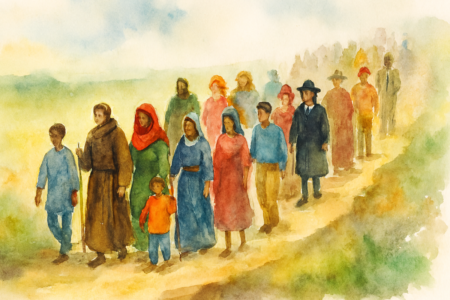
immigrants across time, longing for home.
Christians see this truth in the very first story of Scripture: Adam and Eve, exiled from Eden, became the first immigrants. Their home was lost, and their lives began in displacement. From that moment, humanity has lived as wanderers, seeking belonging.
Yet this longing for another home is not unique to Christianity. Many faiths, in their own ways, speak of another life beyond this one – a recognition that we are all passing through, all searching for permanence. Even if we disagree on the details, the shared intuition remains: we are immigrants at birth, longing for a place to belong.
Just this week, a congressman claimed that “America was not founded by immigrants.” But history – and theology – tell a different story. Settlers are immigrants, and humanity itself began in exile. To deny immigration is to deny our shared condition.
The image illustrates what we’re about to look at: exiles, from the Fall of Man through to the present day. A watercolor painting of a diverse group of people – men, women, and children of different races and historical eras – walking together along a winding dirt path. Their clothing reflects ancient, medieval, and modern styles, symbolizing humanity’s shared immigrant journey across time.
The First Exile: Adam and Eve removed from the Garden of Eden

If you’re not familiar with the creation narrative in Genesis, please check out:
Jews, Christians, and Muslims all look to Genesis for at least some of their beliefs about creation. Islam has the least shared common beliefs among the three. However, all three believe Adam and Eve were removed from the Garden of Eden by God.
So, while there may not be 100% agreement as to the adjacent image, all three of the Abrahamic religions do accept the exile of Adam and Eve from Eden.
What does the exile of Adam and Eve mean?
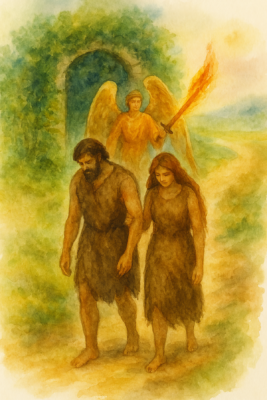
Adam and Eve
removed from the Garden of eden
In addition to Jews, Christians, and Muslims believing that Adam and Eve were exiled from the Garden of Eden by God, there are many other belief systems that also have similar events. The concept of humans having a life beyond this one isn’t limited to just those three religions.
TO reiterate a portion of the opening:
Christians see this truth in the very first story of Scripture: Adam and Eve, exiled from Eden, became the first immigrants. Their home was lost, and their lives began in displacement. From that moment, humanity has lived as wanderers, seeking belonging.
Yet this longing for another home is not unique to Christianity. Many faiths, in their own ways, speak of another life beyond this one – a recognition that we are all passing through, all searching for permanence. Even if we disagree on the details, the shared intuition remains: we are immigrants at birth, longing for a place to belong.
If we look at the news, people all over the globe are being forced to leave what they considered their homes, homeland, country, whatever they may call it.
So, while the image isn’t what we see with Adam and Eve, with an angel preventing them from returning to their homes is hard to avoid in this world we live in today.
It’s a scene repeated, literally, since the beginning of our time on this earth, as human beings created by God to the three Abrahamic religions, or by a god in other belief systems. Whether or not we share beliefs about our origins, who or what created us, or whether or not we’re just an accident of nature, that image of Adam and Eve is something we can all relate to.
Let’s move on and see just how true that is. In fact, we’ll find out it’s more true now than ever.
Exiles in the Old Testament
Let’s check out just three examples from the Old Testament. Both Jews and Christians read the Old Testament. Muslims read many portions of it, although they have different teachings about it. Others also have beliefs that are similar to many of the events. Archaeologists are finding more and more evidence that these events are real.
So again, let’s put aside the religious differences, and let’s look at our shared history, experiences, and the dreams and aspirations we have for our future. Why? Because they should at a minimum, bring us to recognize that we may have different beliefs, but there are so many things we have in common that we should treat each other better than we do.
Abraham
Let’s begin with Abraham. The same Abraham (aka Abram initially) who is considered by the three religions above to be the father of their religion.
Ge 12:1 The LORD had said to Abram, “Leave your country, your people and your father’s household and go to the land I will show you.
Ge 12:2 “I will make you into a great nation
and I will bless you;
I will make your name great,
and you will be a blessing.
Ge 12:3 I will bless those who bless you,
and whoever curses you I will curse;
and all peoples on earth
will be blessed through you.”
Ge 12:4 So Abram left, as the LORD had told him; and Lot went with him. Abram was seventy-five years old when he set out from Haran. 5 He took his wife Sarai, his nephew Lot, all the possessions they had accumulated and the people they had acquired in Haran, and they set out for the land of Canaan, and they arrived there.
Ge 12:6 Abram traveled through the land as far as the site of the great tree of Moreh at Shechem. At that time the Canaanites were in the land. 7 The LORD appeared to Abram and said, “To your offspring I will give this land.” So he built an altar there to the LORD, who had appeared to him.
Ge 12:8 From there he went on toward the hills east of Bethel and pitched his tent, with Bethel on the west and Ai on the east. There he built an altar to the LORD and called on the name of the LORD. 9 Then Abram set out and continued toward the Negev.

What religion was Abram/Abraham?
What religion was Abraham? After all, he is claimed as the father of Judaism, Christianity, and Islam. Two of those religions took one path to get from Abraham to their religions that exist today. However, the other one took a different path to get from the man who used to be Abraham to that religion today.
And off he goes.
Exiled, to be sure. By God, but still told to leave his land. The reality is that, throughout the Bible, God’s people are often being told to leave someplace by Him, or they’re forced to leave someplace when they’re conquered. And of course, it also worked the other way, that God and His people forced others to leave areas they were inhabiting.
We have a couple choices on how to deal with these seeming totally wrong events. I know it’s hard for us, but we need to take the wide view and realize the things wrong in this world go back to the first exile. They screwed up. Had it been us, let’s be honest, we’d have screwed up as well. If you need evidence of that, look in the mirror and ask the person you see if they’re perfect.
The question is what do we do? Do we repeat the same behavior, over and over again? In reality, repeat it over and over but also bigger and more brutal, over and over again.
I wonder, what would we do if we could realize we’re all in the same boat? All looking for something better. All not in the place we came from. That we’re all immigrants with a story.
And we’re all immigrants looking for a home.
You know, it occurs to me that even those who believe there’s nothing after this life are still looking for a home – albeit in their own way.
But let’s not get too far ahead of ourselves. Let’s keep moving forward in Old Testament times.
Israel in Egypt
Every now and then archaeologists discover evidence of past events recorded in the Bible. Just the other day I saw an article in the news about finding evidence of the Exodus of the Israelites from Egypt to the Promised Land. It must be getting harder and harder to dismiss events like that as myth or fable.
The events of the Exodus are way to much to go into here. The very short Reader’s Digest version is this: God’s people were in Egypt because God Himself set up a series of events in Genesis to lead them to Egypt to survive a famine that was coming. But after a while, they turned away from God. So, as He said He would, God turned away from them and let them do as they wished. It’s the now classic lesson – be careful what you ask for – you might get it. Well, they got it. And they were put into slavery by the Egyptians. Then they called out to God for help.
…
Ex 3:5 “Do not come any closer,” God said. “Take off your sandals, for the place where you are standing is holy ground.” 6 Then he said, “I am the God of your father, the God of Abraham, the God of Isaac and the God of Jacob.” At this, Moses hid his face, because he was afraid to look at God.
Ex 3:7 The LORD said, “I have indeed seen the misery of my people in Egypt. I have heard them crying out because of their slave drivers, and I am concerned about their suffering. 8 So I have come down to rescue them from the hand of the Egyptians and to bring them up out of that land into a good and spacious land, a land flowing with milk and honey-the home of the Canaanites, Hittites, Amorites, Perizzites, Hivites and Jebusites. 9 And now the cry of the Israelites has reached me, and I have seen the way the Egyptians are oppressing them. 10 So now, go. I am sending you to Pharaoh to bring my people the Israelites out of Egypt.”
…
So we see, if we look at the full context:
- God saved the Israelites by sending them on an “exodus” to Egypt.
- The people turned away from God and got caught up in slavery
- God again saved the Israelites by sending them on “The Exodus” to the Promised Land.
What’s an exodus got to do with immigrants?
An exodus is often remembered as a triumphant departure – God’s people leaving Egypt for the Promised Land.
An exile is usually seen as punishment or loss – God’s people driven out of their home into Babylon or beyond.
Yet in both cases, the Israelites were immigrants: displaced from one land, seeking belonging in another. Whether celebrated as deliverance or lamented as banishment, the common thread is movement under compulsion, a journey away from what was familiar. Both exodus and exile remind us that immigration is not only about choice, but about survival and identity.
There are more examples of exiles and immigrants in the Bible. I hope these give an idea of the realities of exiles and immigrants in the early days of the Biblical period.
What does the Bible say about immigrants?
Yes, I’m going to quote from the Bible. It’s only natural, since that’s my scripture. And yet, whether you’re Christian or not, there’s a very good chance that whatever belief system you follow, there’s something similar in it. I’m also pretty sure that there’s nothing in it that contradicts what I’m about to show you.
Commands From God in the Book of Exodus
There are two commands God gave to the Israelites He just led out of Egypt. We should take note that, in this light, the Exodus was 1) a way to save the Israelites from slavery, but also 2) a teaching moment to let them realize that they know perfectly well what immigrants go through and should treat them kindly.
…
Ex 23:9 “Do not oppress an alien; you yourselves know how it feels to be aliens, because you were aliens in Egypt.
…
That probably sounds pretty obvious. I mean, it’s Justice and Mercy. Of course they’ll treat each other OK. Don’t we all do that? Oh. Sorry – maybe I shouldn’t have asked that?
But the next one, well, it’s just plain the way to treat everyone.
…
Ex 22:21 “Do not mistreat an alien or oppress him, for you were aliens in Egypt.
…
Oh – wait a second. Aliens / immigrants aren’t really “us” are they? So, it really doesn’t make any difference what country, region, whatever someone comes from.
That’s why I reversed the order of the verses, with chapter 22 after 23. It drives home the reality of the command to treat all immigrants the way we’d want to be treated if we were one. And then, as I’m proposing, every single one of us is an immigrant. Even if we choose to not accept that reality, we are.
So now, let’s continue with a huge time leap to now.
Exiles in the World Today
I could put in some examples from today. But why? If you don’t already know, just open up your browser and go to world news. Sadly, for way too many so-called developed countries, like the U.S. and many in Europe, you can even check out your national news. We even have a war on immigrants here in the U.S. with threats/plans to even people immigrants of their citizenship.
Has there ever been a time in recorded history when more people are being forcibly displaced around the world then what’s going on now?
Sadly, I was expecting the response I got back.
Yes – as of 2025, the world is experiencing the highest number of forcibly displaced people in recorded history, surpassing all previous decades.
🌍 Current Global Displacement Numbers
- 122.1 million people were forcibly displaced worldwide by April 2025 – the highest ever recorded by the UN Refugee Agency (UNHCR).
- This includes refugees, asylum seekers, and internally displaced persons (IDPs) – people forced to flee due to war, persecution, or disaster.
- 83.4 million are internally displaced within their own countries, also a record high.
🔥 Key Drivers of Displacement
- Sudan: Civil conflict and flooding have displaced millions.
- Myanmar: Ongoing violence and persecution continue to drive mass displacement.
- Ukraine: War has created one of the largest refugee crises in Europe since WWII.
- Palestine, Lebanon, Congo, Syria: Long-term instability and renewed violence have added to the global surge.
- Climate-related disasters: Floods, droughts, and storms – often intensified by climate change – are now major contributors to forced migration.
📈 Historical Comparison
Unlike past eras, today’s displacement is global, prolonged, and increasingly driven by overlapping crises – war, climate, economic collapse, and political instability.
The current numbers exceed even post-WWII displacement levels, which were previously considered the highest in modern history.
Wow. I almost don’t know what to say. Almost.
But it gets worse.
“America was not founded by immigrants”
Is that mind blowing or what?
It’s part of the headline I read with shock this morning: “America was not founded by immigrants”
While President Donald Trump complained about Somalis living in Minnesota and referred to them as “garbage” during his cabinet meeting on Tuesday, MAGA-aligned U.S. Representative Andy Ogles (R-TN) wrote on social media: “America was founded by settlers and missionaries, not immigrants. Coming to America was always about duty, not entitlement. Deport all illegals!” 1https://www.msn.com/en-us/news/politics/us-congressman-says-i-work-with-morons-after-maga-rep-claims-america-was-not-founded-by-immigrants/ar-AA1REEzg
After everything you just read, can you even think that anyone has a duty to go to another land and do to its residents the kinds of things that have been done to them by anyone who’s gone in and conquered, destroyed, killed, in any way even remotely close to what people have done to each other throughout the ages?
Who among us, if we were an immigrant in this or any other country in the world, would want to be treated like that?
It’s not just America
And it’s not just America. It’s a feeling that seems to be spreading around the world. There’s a pattern to it, if we choose to open our eyes and acknowledge it. But too many won’t.
But to some people; like me, I find the people who claim to be Christians, imply they’re Christians, seek support from Christians, and the Christians who support this, to be especially unsettling. For those of you of other faiths, I expect and hope that you feel the same way.
Consider what Jesus said:
Mt 5:43 “You have heard that it was said, ‘Love your neighbor and hate your enemy.’ 44 But I tell you: Love your enemies and pray for those who persecute you, 45 that you may be sons of your Father in heaven. He causes his sun to rise on the evil and the good, and sends rain on the righteous and the unrighteous. 46 If you love those who love you, what reward will you get? Are not even the tax collectors doing that? 47 And if you greet only your brothers, what are you doing more than others? Do not even pagans do that? 48 Be perfect, therefore, as your heavenly Father is perfect.
It’s hard to imagine anything other than people with attitudes like that towards immigrants consider them to be enemies.
That’s why, for anyone who even implies they’re Christian, treatment such as what we just read is not only unacceptable but a statement against God. What else can it be when Jesus says love everyone, even the people you hate?
Like I said, I’m Christian. But we aren’t the only ones who believe this kind of treatment is wrong. And yet, too many of us seem to be voting for someone who is the antithesis of the beliefs we have in so many areas, including how to treat immigrants.
Or any person at all for that matter.
It’s not just an American problem.
It’s not just an immigrant problem.
What it is – is that way too often, we just don’t treat each other well at all.
And if we stop to consider it all – maybe we’ll wonder, “Why not?”
Longing Beyond Exile
From Eden to Egypt, from exile to exodus, the story of humanity has always been one of movement – of leaving, longing, and searching for home. Whether celebrated as deliverance or lamented as banishment, the Israelites were immigrants in both cases, displaced from one land and seeking belonging in another. That same pattern repeats across history and into our own time, as millions are forced to leave behind what they once called home. The language may change – exile, exodus, migration – but the reality is the same: we are all wanderers, all immigrants, longing for permanence.
And even one of the most brilliant scientific minds of our age could not escape that longing. Stephen Hawking once said, “I regard the brain as a computer which will stop working when its components fail. There is no heaven or afterlife for broken down computers; that is a fairy story for people afraid of the dark.” For all his brilliance, he still had to reach for an answer. His conclusion was sad, but his search reminds us that the longing itself is universal – and that longing points us toward hope.
Footnotes:
- 1https://www.msn.com/en-us/news/politics/us-congressman-says-i-work-with-morons-after-maga-rep-claims-america-was-not-founded-by-immigrants/ar-AA1REEzg ↩︎
Discover more from Which god can save?
Subscribe to get the latest posts sent to your email.