
Faith, Language, and the Journey of Understanding
This site began not with politics or public discourse (like my other current site), but with an invitation to lead a Bible study — one I felt wholly unqualified for. Back in 2002, I was asked to step in at a Chinese-speaking church with a small English-speaking group, mostly international college students. I was the only native English speaker, and suddenly I had to explain not just Scripture, but the language itself. That experience—equal parts terrifying and transformative—planted the seeds for what would become a lifelong passion: exploring the depth of God’s Word through language, translation, and context.
Years later, I was asked to lead an adult Bible study at a new church, this time for native English speakers, many older than me. Again, I was nervous. But the habit of digging into Hebrew and Greek roots, comparing translations, and seeking clarity became a method—and a joy. Some resisted at first. Now they enjoy it. So do I. That’s why I write God versus Religion: to share what I’ve learned, to keep learning, and to help others see the richness of Scripture beyond surface-level reading.
What helped make me who I am?
Since my first experience leading Bible Study included explaining English, curiosity about the Hebrew and Greek words was a natural extension. I began to realize our understanding of the Bible was limited. Just as people in that first class didn’t understand English, we don’t understand Hebrew or Greek. So, they didn’t understand our translations. And we don’t understand the original languages of the authors of the Bible. In other words, we don’t understand the original inspired words of God.
The more I got into that, the more I needed to learn to go with it. Cultures. History. The roots of Christianity – no covenant to the first covenant to the second covenant. The good, the bad, and the ugly. All of it led to who we are and what we have today.
Everything along the way was like opening new doors. Doors that explained more about God. What His words mean then. And through the lens of the people to whom it was written, a better understanding of what it means for us today.
All of those doors led to more context. Context is key to understanding God’s Word. Without context, we pull out verses with little to no understanding of their meaning. We remake God into our image.
I wish more people had time to explore the original context of Scripture. I’ve spent years studying the Hebrew and Greek roots of biblical texts, alongside the history, culture, and religious frameworks of the time. I believe that understanding how the original audience received the message is essential to faithfully translating its meaning for today.
I try to bring that experience to the things I write – hopefully allowing readers to gain something of a deeper understanding as well.
What brought about my writing style and delivery?
My approach to writing in general and accessibility in particular, is shaped by personal experience. In the early days of computing, when knowledge was hard to come by and rarely shared, I learned the value of open access and inclusive design. Later, I worked with a university disability coordinator to ensure that web content met accessibility standards and served users of all abilities. That ethic of transparency and usability continues to guide my work.
I also try to write in a conversational tone, as much as possible. I never liked reading academic books, full of fancy words that no one on the “outside” knew. It’s just too hard to learn when you have to keep stopping to find definitions of words that turn out to mean basic things.
Trustworthiness is at the heart of my work. I lived through spiritual wandering and return, and try to write with understanding and empathy for those on similar journeys. As a cancer survivor and someone who still faces depression, I try to bring vulnerability and resilience to my writing. My decades at a major university exposed me to a wide range of nationalities, races, and lifestyles—and taught me the value of listening and respect.
What sites do I write?
I’ve been writing since about 2010. Currently, I have three sites up and running.
- whichgodcansave.org – (You are here)This new site, as much as possible, has less on the scripture side, and more on culture, ethics, government, and the like. The goal here is to consider the other “gods” that we have in our lives – and look at how they impact our views of Christianity. It even looks at false views of Christianity, urging the reader to try to view God the way He described Himself in the Bible – rather than someone’s view of Him that doesn’t line up with what the Bible says.
- godversusreligion.org – (My companion site) This new site has an emphasis on scripture, theology, history, culture – all the elements of reaching full context. It contains my own thoughts, often with quotes and background from Christian scholars, commentators, and pastors. It’s presented from a core of my beliefs, theologically mostly middle of the road, but when there are disagreements, I include other sides, along with the passages they use to support their views. The idea is to give you more understanding, with the goal of you being able to “own your own faith”.
- godversusreligion.com – (My legacy site) It still has hundreds of old articles, written for various Christian audiences. It’s reached a point where it became too difficult to maintain, and is now being migrated to one of the other two sites. The legacy site had various topics, formats that changed over time due to technology upgrades, and has little to no accessibility capabilities.
Why do I do this?
I keep my sites independent and personal to preserve integrity. I write every post myself, drawing from my beliefs and research, and presenting multiple viewpoints with sources for and against. My goal is not to convince, but to clarify—offering my own understanding while leaving space for others to hold their own. With so many denominations and interpretations of Christianity, I believe only God truly knows the heart, and that’s what ultimately matters – and that humility is essential in all discourse.
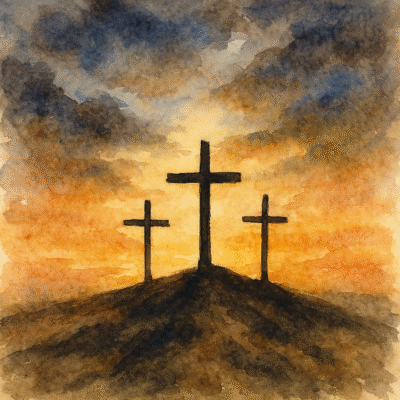
The image of the three empty crosses with light breaking through reflects a significant shift in my own journey. Growing up Catholic, I was used to seeing Jesus on the crucifix. Transitioning to Protestant churches, the absence of Jesus on the cross initially felt odd – until the profound truth settled in: Jesus is risen. He isn’t on the cross anymore, and He left us the Holy Spirit to guide us.
Seeing Jesus on the cross was a reminder of why Jesus had to die, to pay for my sins. But now, still realizing that, the focus is on the reality that we’re forgiven.
Together, those realizations are the driving force behind everything I write.