
Already but not yet
-
📖 “Already But Not Yet” Paradox: The theological concept that God’s kingdom is a present spiritual reality experienced through faith and obedience right now, but its full, perfect expression will not be realized until the future.
I’ll use the AI generated image below to describe something about how the “already but not yet paradox” is believed to work.
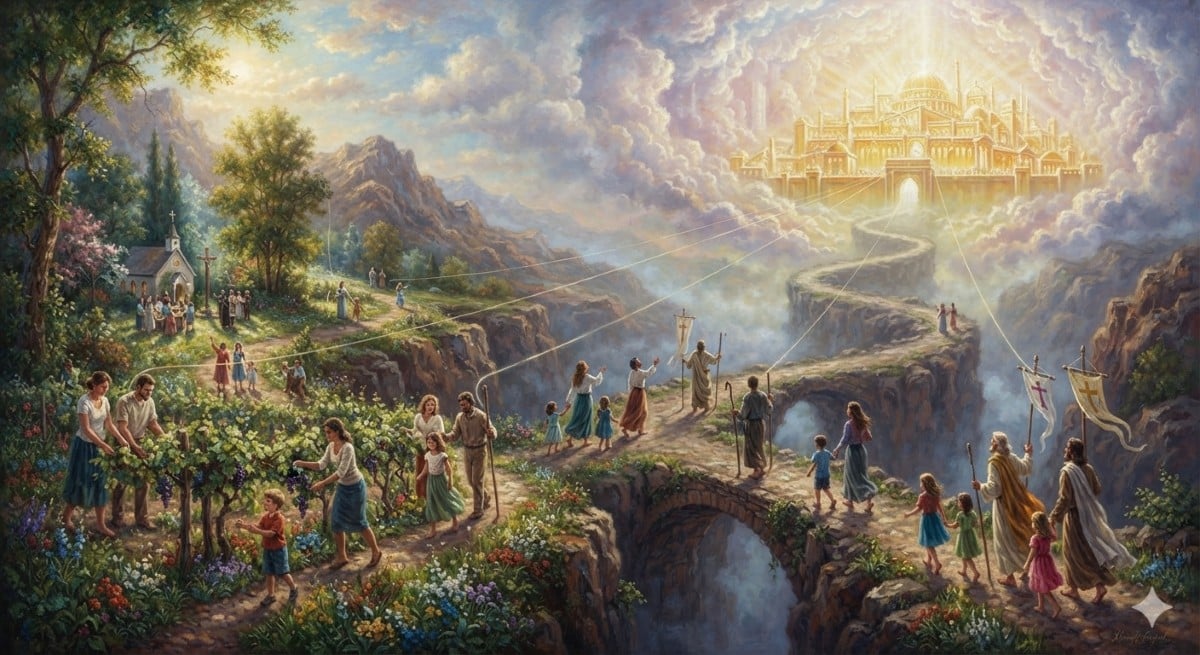
This surrealist oil painting captures the dual reality of the “already but not yet” paradox. In the foreground and middle ground, groups of people are actively engaged in earthly life—tending to vibrant vineyards, harvesting crops, and walking with families along a winding, rugged mountain pathway. A small, rustic church sits nestled in the green hills to the left.
Thin, glowing golden threads stretch from the hands of the people and the landscape below, reaching upward across a vast chasm. These threads connect directly to a massive, majestic golden city of light floating high in the distant clouds. The sky is filled with voluminous, soft clouds illuminated by a brilliant, heavenly glow emanating from the floating city, symbolizing a future kingdom that is simultaneously being built and experienced in the present moment.
Please realize – this is a symbolic representation. It’s not meant to represent physical realities.
I began this research with a short statement of my own about us and the Kingdom of Heaven – in this life and the next:
As Christians, we hope our eternal destination is in God’s Kingdom. Somewhere in our journey to become mature Christians, we also realize that even in this life, we are already – to varying degrees – part of God’s Kingdom.
Then, I presented that statement to the Faithlife/LOGOS AI to give an analysis of it, based on its library of Christian authors. Here’s its response:
🤖✨ Yes, your statement aligns with biblical theology. Believers are actively taking part in the kingdom of God, although the kingdom will not reach its full expression until sometime in the future.1 The framework you’re describing reflects what theologians call the “already but not yet” paradox.
Jesus declared the kingdom of God as a present reality that could be experienced by those He taught and to whom He ministered.2 At the same time, Jesus’ teaching also assumed the kingdom was a future reality, with Paul speaking of the kingdom as something that could be inherited and does not perish.2 This dual dimension means Christians occupy a unique spiritual position: we participate in God’s reign now through our faith and obedience, yet we await its complete manifestation.
The tension you identify becomes clearer when we consider what this participation looks like. As believers in Christ, we have been rescued from the kingdom of darkness and brought into the kingdom of the Son, with the kingdom of God functioning within us, providing righteousness, peace, and joy in the Holy Spirit.3 Yet simultaneously, the kingdom had not been fully manifested in Jesus’ day—nor has it in ours, as we do not yet live in a world where God’s will is a complete reality, and we feel the tension of experiencing God’s kingdom in our lives and communities before it is fully realized.2
Your observation about spiritual maturation is insightful: recognizing our present membership in God’s kingdom while awaiting its future consummation represents a deepening understanding of Christian hope and identity.
1 Got Questions Ministries, Got Questions? Bible Questions Answered (Bellingham, WA: Faithlife, 2014–2021). [See here.]
2 John D. Barry et al., Faithlife Study Bible (Bellingham, WA: Lexham Press, 2012, 2016). [See here, here, here, here.]
3 Laurie R. Matthias, The Cry of the Teacher’s Soul (Eugene, OR: Wipf and Stock, 2015), 22.
I will have a follow-up article that goes into this in more detail and with greater explanation. A link will be added here when it’s published.
Discover more from Which god can save?
Subscribe to get the latest posts sent to your email.