
In the first part of this series, we looked at how easily the word love slips through our fingers. We use it for everything from sushi to strangers, from preferences to passions, until the word stretches so thin it can mean almost anything – and therefore almost nothing.

But there’s a deeper reason love has become weightless. It isn’t just overuse. It isn’t just confusion. It’s disconnection.
Somewhere along the way, we tried to talk about love without talking about God. We tried to define love by our desires, our politics, our feelings, our moment in history – anything except the One Scripture says is love. And when you separate a word from its source, you shouldn’t be surprised when it loses its substance.
That’s the real problem underneath all the others. Love without God isn’t just thin. It’s unstable. It bends toward whatever we want it to mean.
And once we start redefining love, we inevitably start redefining God – or replacing Him altogether. That’s not a new problem; it’s as old as Eden. But it’s a problem that shapes everything happening in our culture today, including the conflicts inside the church itself.
The image above is a conceptual watercolor illustration of two red hearts on a soft, neutral background. The heart on the left is semi-transparent with faded edges and a barely visible jagged crack down the center, symbolizing a heart unaware of its brokenness. The heart on the right is solid, vibrant, and intact, representing the restoration God offers through His love. The image evokes a quiet emotional contrast and invites reflection on the choice between settling for a fractured version of love or receiving the fullness of love from its true source.
The idea behind that image is what we’re going to examine in this segment. We’re going to slow down and ask a harder question: What does love look like when we let God define it? Because if love comes from God – as John insists – then the only way to recover the weight of love is to return to the God who gives it.
Series Note:
This article is part of the larger journey How Did We Get Here?, where I trace the deeper spiritual, emotional, and cultural patterns that have shaped the way we think about God, love, and ourselves. Each article and subseries stands on its own, but together they form a narrative of how we arrived at the confusion and longing we live with today. See the entire series: How Did We Get Here?
This article is also Part 2 of The Problem of Love Without Caring. In Part 1, we explored how love has become a word without weight – stretched thin by overuse and emptied by confusion. Here in Part 2, we go a layer deeper. We look at why love lost its weight in the first place, and why separating love from God leaves us with something that can’t hold us, guide us, or change us. Part 3 will turn toward what Christian faith is meant to restore – a way of living that learns love from its true source. See the entire series: The Problem of Love Without Caring
Update – 2026
Update Notes (2026):
This post was originally written in 2019 and is preserved here as part of the How Did We Get Here? series. It has not been rewritten for content. Updates include accessibility improvements (headings, spacing, alt text), minor grammar and spelling corrections, and a few brief present‑day notes for clarity.
The heart and candle images were added to illustrate the ideas in part 2 of The problem of love without God.
God’s kind of love
This may sound so deep and complicated, So, let’s begin really simply, God’s kind of love is, in a word, God.
So, let’s take a look at the difference between God’s love and ours. You know, I find this difference incredibly hopeful. We all have issues with the way the world is now, whether it’s individual relationships, world events, or anywhere in between. BTW, that includes even our relationship with ourselves! With that view in mind, let’s see what Joun said about God, love, and us.
God’s Love and Ours – 1 John
1Jn 4:7 Dear friends, let us love one another, for love comes from God. Everyone who loves has been born of God and knows God. 8 Whoever does not love does not know God, because God is love. 9 This is how God showed his love among us: He sent his one and only Son into the world that we might live through him. 10 This is love: not that we loved God, but that he loved us and sent his Son as an atoning sacrifice for our sins. 11 Dear friends, since God so loved us, we also ought to love one another. 12 No one has ever seen God; but if we love one another, God lives in us and his love is made complete in us.
When John writes, Dear friends, let us love one another, the audience is other Christians. He says love comes from God. As an example of God’s love for us, John writes about Jesus. Given that, we’re clearly talking about Christians as people who believe Jesus is the Son of God. Also, we believe that Jesus died on the cross, was resurrected, and returned to Heaven. Without those basic beliefs, John’s conclusion in verse 10 makes no sense.
Calling ourselves Christian is meaningless unless we believe this is love: not that we loved God, but that he loved us and sent his Son as an atoning sacrifice for our sins. While that may sound obvious, it apparently isn’t. At least 25% of people who claim to be Christian do not believe that Jesus was resurrected from the dead. Again – unless we believe that, His sacrifice cannot exist. There’s no forgiveness. And God’s love is as meaningless as me loving ikura sushi with a quail egg on top (from part 1 – The problem of love without caring).
That’s important for everyone to realize. Including those of you who are non-Christians. If your view of Christianity is negative because of people who don’t believe and/or don’t live as if they don’t believe this, know that their basic beliefs are 180 degrees opposite of what the Bible teaches. And their view of “love”, because of that, is skewed.
As for non-Christians who don’t believe what I just wrote about Jesus, that’s OK. You’re not claiming to be Christian. I have nothing against you. I do hope to convince you to take (another?) look at what Christianity really is, but it’s not my place to judge you.
God is love
1Jn 4:13 We know that we live in him and he in us, because he has given us of his Spirit. 14 And we have seen and testify that the Father has sent his Son to be the Savior of the world. 15 If anyone acknowledges that Jesus is the Son of God, God lives in him and he in God. 16 And so we know and rely on the love God has for us.
God is love. Whoever lives in love lives in God, and God in him. 17 In this way, love is made complete among us so that we will have confidence on the day of judgment, because in this world we are like him. 18 There is no fear in love. But perfect love drives out fear, because fear has to do with punishment. The one who fears is not made perfect in love.
This part of the passage is the source for when Christians say that “God is love”. It has some examples and the reasons why “God is love” is so important. To step away from these verses and redefine love as something else is to redefine God. In other words, to have a different view of love, one based on our wishes for what we want love to mean, is to redefine God in our image. And then, God ceases to be God. We then have a different kind of love, one without caring.
Also, by this action, we’ve made ourselves into god. Or, at the very least tried to put ourselves above God. As you may remember, that’s the very scenario from the Garden of Eden.
The Fall of Man – Genesis
Ge 3:1 Now the serpent was more crafty than any of the wild animals the LORD God had made. He said to the woman, “Did God really say, ‘You must not eat from any tree in the garden’?”
Ge 3:2 The woman said to the serpent, “We may eat fruit from the trees in the garden, 3 but God did say, ‘You must not eat fruit from the tree that is in the middle of the garden, and you must not touch it, or you will die.’ “
Ge 3:4 “You will not surely die,” the serpent said to the woman. 5 “For God knows that when you eat of it your eyes will be opened, and you will be like God, knowing good and evil.”
Understanding the importance of this is critical. And as we saw above, there are way too many people who believe/think they’re Christians and are truly following Jesus’ teachings. So, I need to ask this question: For those of you who are Christian, tell me – do you really want to go there? Especially for those who are Christian leaders, tell me – do you really want to go there? Christian leaders, of all people, really have to know where this is going to end up. Hint – it’s not a good place. Don’t be redefining love. Don’t be redefining God.
We love because he first loved us
Now, let’s return to the closing paragraph of “God’s Love and Ours” from 1 John.
1Jn 4:19 We love because he first loved us. 20 If anyone says, “I love God,” yet hates his brother, he is a liar. For anyone who does not love his brother, whom he has seen, cannot love God, whom he has not seen. 21 And he has given us this command: Whoever loves God must also love his brother.
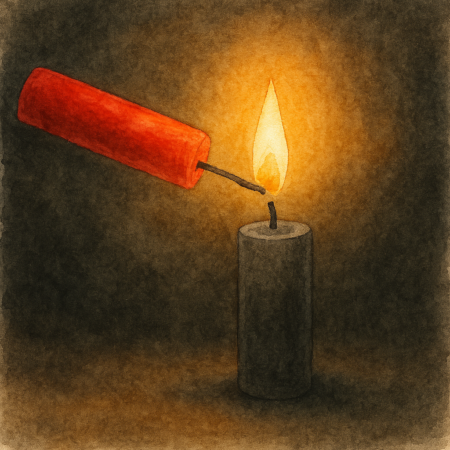
The image of the two candles is a visual representation of “We love because he first loved us“.
The gray candle is us. We’re gray because we don’t truly understand love to it’s fullest extent. Yes, we have certain concepts about love. But they’re minimal compared to what God’s love is.
The red candle is God. It’s red to symbolize Jesus’ death on the cross. Under the New Covenant, Jesus is the way to restore our relationship with God that was lost in Eden after The Fall. No, it doesn’t restore it completely. That won’t happen in this life, but in the next.
The image shows an offer from God to us. An offer to begin that process of restoration. If you look closely, you’ll see the flame from the red candle doesn’t quite touch the wick on the gray candle. That represents God coming down from Heaven to be with us. Jesus’ birth, 3-year ministry on earth, suffering and death on the cross, resurrection from the dead, and ultimate return to Heaven.
Yes, God did all that. But we also need to do something. We need to believe, as in John 3:16 below. Only then will the red candle light the gray candle. Only when we accept God’s offer of salvation through Jesus will our gray candle be lit. Our understanding of God’s love can begin. If we accept the offer.
Now, do you see what I meant with that question above? Knowing and trying to live out God’s kind of love is critical for a Christian. Of course, I also believe it is for non-Christians. However, as I said, while I encourage you to check this out – I also know Christians are told not to judge non-believers.
The implications of “We love because he first loved us”
This brings in two important points. First – that we love because God loved us first. Second, it brings in the contrasting issue of hate.
Yes, God did love us first. I know, Adam and Eve got kicked out of the Garden of Eden. But it’s not like it was for no reason. They got plenty of warning. If anything, they deserved worse. After all, looking at the literal Hebrew from Genesis, God told them they would die die. Yes – die is there twice, it’s not a typo. For more on that whole Eden incident, please see Why were Adam and Eve kicked out of the Garden of Eden? and The Problem of Free Will.
The New Testament opens with yet another example of God’s love. Jesus – who we read about above. And remember what’s probably the single most famous verse in the Bible, one which shows great love and caring:
Jn 3:16 “For God so loved the world that he gave his one and only Son, that whoever believes in him shall not perish but have eternal life.”
Once again, we really shouldn’t be redefining God’s love. Jesus died, for us, because of God’s love. The very same love that some are trying to redefine. For a non-Christian to do this, it’s understandable. For a Christian to do it, it’s beyond belief. God’s love is at the very core of what we believe. How can we even want to change it?
I love God but hate my brother
🔍 Reflective Insight
By now, hopefully it’s apparent that it’s just not possible to love God but hate someone else.
Actually, it is possible. Sort of. We do it a lot.
But when it happens, one of maybe four things is going on.
- We’re messed up in our definition of hate.
- The person isn’t Christian. As above, I’m not judging non-Christians. Without the belief in Jesus as the Son of God and that He’s our Lord and Savior, and without any attempt to try to live a Christian life, there’s no expectation that they even have a true understanding of God and God’s love.
- The person is Christian, but emotions have temporarily taken over. Emphasis on the word temporary. We’re fallen people. It happens. The thing is to return to our faith and try to live in a fashion that shows God’s love. Plus, over time, we should grow in our faith and ability to resist the temptation to feel something other than love.
- We don’t love God the way He loves us. We’ve redefined love. And once again, that means we’ve redefined God. Not a good place to be.
What is hate?
Presumably, hate is the absence of love. Dictionary.com says:
Hate:
verb (used with object), hat·ed, hat·ing.
to dislike intensely or passionately; feel extreme aversion for or extreme hostility toward; detest: to hate the enemy; to hate bigotry.
to be unwilling; dislike: I hate to do it.
verb (used without object), hat·ed, hat·ing.
to feel intense dislike, or extreme aversion or hostility.
noun
intense dislike; extreme aversion or hostility.
the object of extreme aversion or hostility.
OK, but exactly what is it that is hated? That’s a question that needs to be answered.
But before we go there, let’s look at the Biblical meanings, both Old and New Testament. We can’t really look at the usage of a word today, knowing that love has lost its meaning from Biblical times, and still expect to learn about love or hate.
HATE (Heb. śānē˒; Gk. miséō).
Aversion or hostility. Biblical usage represents a broad range of nuances from intense malice to simple disregard as expressed between individuals and groups and between God and mankind.
Myers, Allen C. The Eerdmans Bible Dictionary. Grand Rapids, MI: Eerdmans, 1987.
We start off the same – aversion and hostility. However, the wide range of the intensity of the hatred, and the introduction of God are both new.
According to the Old Testament, hatred may stem from wickedness (Ps. 26:5), ill will (25:19), apostasy (101:3), or political differences (Dan. 4:19 [MT 16]).
Myers, Allen C. The Eerdmans Bible Dictionary. Grand Rapids, MI: Eerdmans, 1987.
Even the differences between people within a religion can be, but aren’t always, political.
The wicked hate those who are righteous (Prov. 29:10), just as the righteous hate those who sin (e.g., Ps. 119:113, 163).
Myers, Allen C. The Eerdmans Bible Dictionary. Grand Rapids, MI: Eerdmans, 1987.
Note that the part about the righteous hate those who sin was changed by Jesus.
From definitions to scripture
Definitions are one thing. They are informational. The thing is – what do we do with that information? We can use words to confirm our position. We can use those same words to strengthen our position. Or, and this is the key, we can use those same words to realize our position has problems – and we can transform our thoughts to align with the words.
In the case of hate, Christians are told to love those who sin, even their enemies. One place to see that is in a passage where Jesus talks about loving even our enemies.
Love for Enemies – Matthew
Mt 5:43 “You have heard that it was said, ‘Love your neighbor and hate your enemy.’ 44 But I tell you: Love your enemies and pray for those who persecute you, 45 that you may be sons of your Father in heaven. He causes his sun to rise on the evil and the good, and sends rain on the righteous and the unrighteous. 46 If you love those who love you, what reward will you get? Are not even the tax collectors doing that? 47 And if you greet only your brothers, what are you doing more than others? Do not even pagans do that? 48 Be perfect, therefore, as your heavenly Father is perfect.”
🔍 Reflective Insight
That’s not easy to do. It’s hard to love people who hate us. And yet, that’s what Jesus says we must do. That’s where the saying, hate the sin but love the sinner comes from. So, when a Christian gets into that discussion about love and hate, and what is it that we hate, it’s important to remember this.
This is also one area where the non-Christian needs to understand what we’re talking about. It’s up to the Christian to actually do what Jesus said – love the sinner but hate the sin. It’s also up to us, when we get into a discussion like this, to try to make the non-Christian aware of this difference. It’s huge.
We have no reason to expect non-Christians to know this. We also have to be sure that we know it and follow it ourselves.
Note: To “hate” God means to reject or break the covenant relationship with God. Redefining God and His love is most certainly breaking the covenant relationship with God. That’s something for every Christian to realize. It’s especially important for our leaders to know that, remember it, and be sure they don’t do it. Otherwise we have something that’s not God’s love and it without His caring.
Myers, Allen C. The Eerdmans Bible Dictionary. Grand Rapids, MI: Eerdmans, 1987.
Please remember, this entire last section, the definitions, the passage, are things Christians have promised to do. It’s part of being a believer.
Not only that, but they are also essential for two things. More than two, no doubt. But two that are most relevant today.
First, in order to experience God’s Spirit, love, joy, peace, and so many other things, we must begin working on loving even our enemies. Imagine what that means for our friends if we love even those who are against us!
Second, hopefully you remember that we’re commanded to perform the Great Commission.
🔍 Key Insight
If we are to have any hope at all of sharing what we have in Jesus, then it’s essential that we actually have something with Jesus! If we say we believe, but don’t truly believe strongly enough to transform our lives, then we’re just like “everyone else” so what is it we think they see that’s different in us?
What is a Christian?
This feels like a good time for a side-trip. A look back to check out Christianity, the name and the people called Christians. Again, remember this isn’t about those who claim to be Christians but believe something else. This is about what Christianity really was when it got started, nearly 2,000 years ago.
Here in part 2 of Love Without Caring, we’ve traced why love feels so thin in our world – not because love itself has changed, but because we’ve tried to live it without the One who defines it. When we disconnect love from God, we’re left with something that looks familiar but can’t carry the weight we place on it. It can’t steady us. It can’t transform us. It can’t heal what’s broken in us or between us.
John’s words make the contrast unavoidable: we love because He first loved us. If we lose the “first,” we eventually lose the “love.”
But this is not where the story ends.
If God’s love is the source, then it’s also the starting point for rebuilding – not just our understanding of love, but our understanding of ourselves. Part 3 turns toward that restoration. It asks what happens when God doesn’t just offer love from above, but reshapes the heart that receives it. It’s where the thin, fragile version of love we’ve known gives way to something stronger, steadier, and far more human than we expected.
Part 3 will explore what Christian faith is meant to restore in us – and why recovering real love requires becoming the kind of people who can actually live it.
Discover more from Which god can save?
Subscribe to get the latest posts sent to your email.